



So what exactly is the Japanese tea ceremony?
The short answer: a ritualized preparation and presentation of matcha — powdered green tea whisked with hot water — performed according to centuries of accumulated aesthetic philosophy. The longer answer is that describing it this way is a little like describing a Cy Twombly as marks on canvas. Technically true. Almost entirely beside the point.
The Japanese tea ceremony — known as chanoyu, sadō, or chadō — is about how tea is offered and how it is received. The atmosphere constructed between host and guest. Every element is considered: the fold of the cloth, the weight of the bowl in both hands, the scroll chosen for the alcove, the single flower cut for the room. The sweets served before the bowl arrives. Even the silence between gestures. Nothing happens by accident. Nothing is meant to look like effort.
The Short Answer
The Japanese tea ceremony is a centuries-old ritual of hospitality, aesthetics, and attention. Rooted in Zen practice and shaped most profoundly in the 16th century, it centers on the preparation and sharing of matcha in a setting where every object, gesture, and moment carries deliberate meaning. To attend one is to step, briefly, outside ordinary time.
Where does it come from?
Tea arrived in Japan from China via Buddhist monks, adopted first by monasteries and then by the aristocracy. Over several centuries, it evolved from an imported habit into something distinctly, irreducibly Japanese. The form most people encounter today was shaped most powerfully in the 16th century by Sen no Rikyu — a tea master whose genius was essentially subtractive. He stripped tea culture of its ostentation, its display of wealth, its borrowed Chinese grandeur, and in its place installed something quieter and more demanding: simplicity, humility, the beauty of the unfinished and the irregular.
Rikyu's aesthetic became the template. His influence is still felt every time a host lifts a bowl.
The four ideas behind the ritual
Tea ceremony is often organized around four ideals: harmony (wa), respect (kei), purity (sei), and tranquility (jaku). These are not decorative concepts. They are the structure. Harmony plays out in the relationship between host, guest, objects, season, and setting — each element tuned to the others. Respect appears in the careful acknowledgment of every person and object involved. Purity is both physical and mental: cleansing as preparation for presence. Tranquility arrives gradually, through repetition and stillness, as the ceremony unfolds.
Together they explain something that is otherwise difficult to articulate: why the experience can feel genuinely moving even if you know none of the formal rules.
The room itself
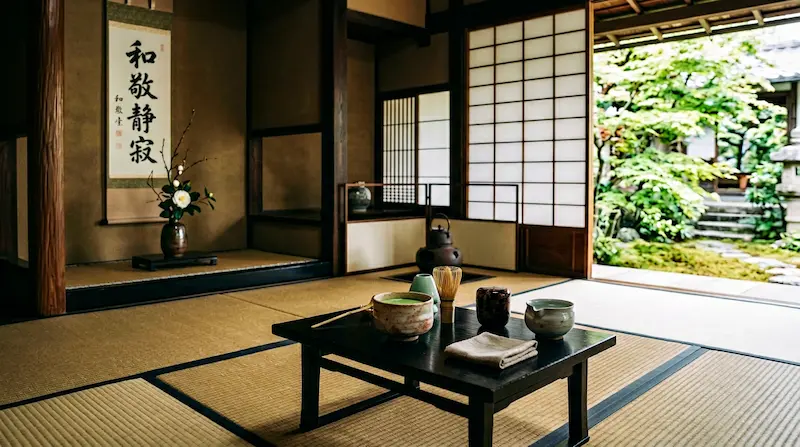
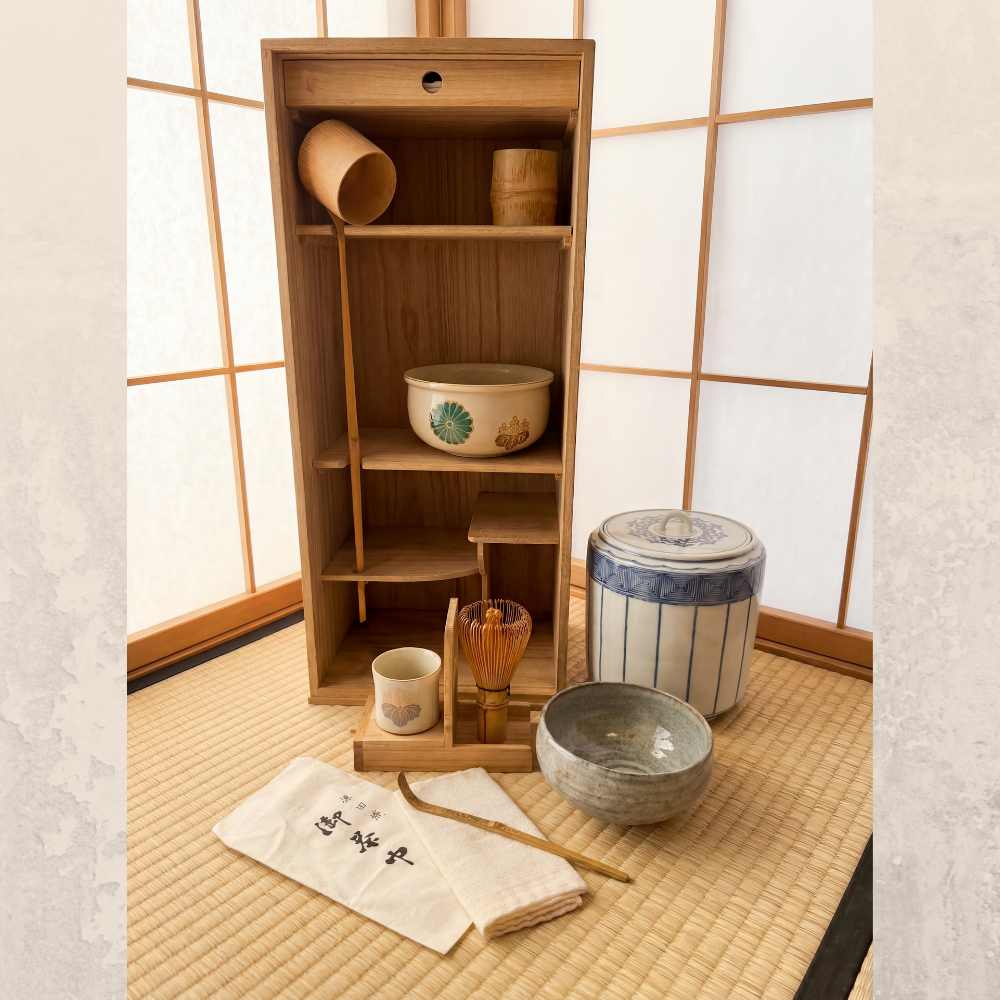
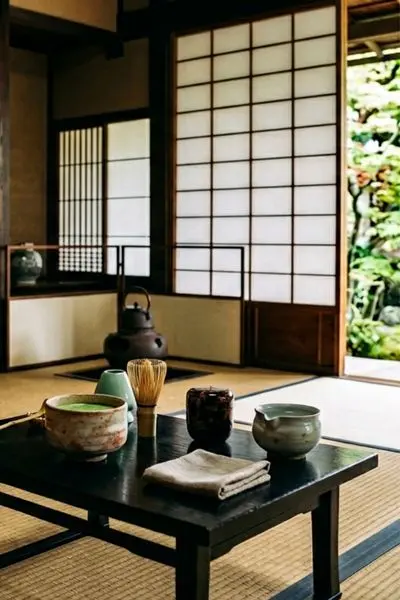
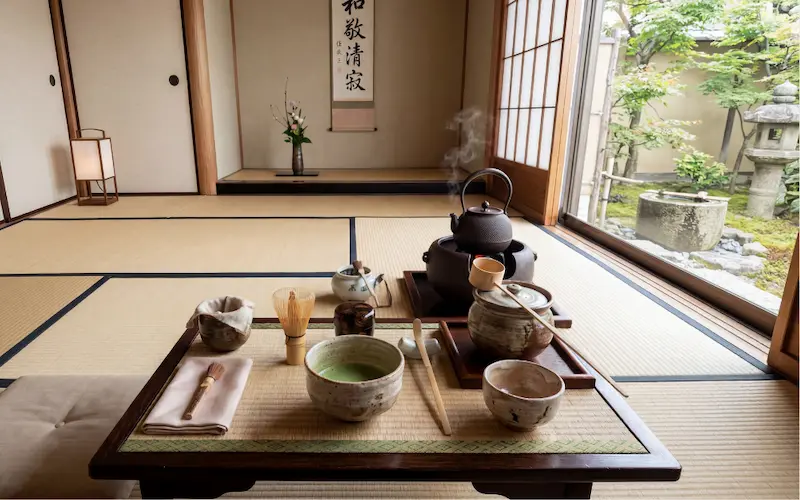
The setting is as important as the tea. Traditional tea gatherings take place in a chashitsu — a tea room designed to separate the experience from ordinary life. The architecture is restrained, intimate, attuned to natural materials: wood, paper, tatami, clay, bamboo, the particular quality of diffused light. In some traditional rooms, guests enter through a nijiriguchi — a low doorway that requires stooping, almost crouching, to pass through. The gesture is not decorative. It is a physical act of humility: you leave title, rank, and ego at the threshold.
Inside, an alcove — the tokonoma — holds a hanging scroll and a flower arrangement, both chosen to reflect the season or spirit of the occasion. The tea ceremony is, in this sense, not one tradition but several converging at once: ceramics, calligraphy, ikebana, lacquerware, textile, seasonal cooking, architecture, garden design. The room is an argument for the idea that beauty is a form of care.
Why imperfect bowls are the most coveted
Many of the most admired tea bowls in Japan are admired precisely because they are not perfect. Irregular. Asymmetrical. Marked by the kiln, by time, by use. The tea ceremony has always had a particular relationship to the aesthetic often described as wabi-sabi — the beauty of imperfection, transience, and quiet incompleteness. A bowl with a crack repaired in gold lacquer (kintsugi) is not diminished by its history. It is made more interesting by it.
In this world, beauty is never loud. It is found through attention.
What first-timers should know about etiquette
The ceremony has formal rules, but its spirit is not one of testing guests. Attentiveness and gratitude carry further than technical knowledge. Enter calmly. Take in the room before you focus on the tea — the scroll, the flowers, the arrangement of utensils. These are part of the ritual. When the bowl is offered, receive it with both hands. In more formal settings, rotate it gently before drinking so your lips do not touch its front face — a gesture of respect for both the object and the maker's intention. Drink with attention, not performance.
The ceremony runs at the host's pace. Follow it. That, more than any specific rule, is the point.
The sweets, and why they matter
Wagashi — traditional Japanese sweets — are served before the tea, not after. They offset the bitterness of matcha, but more than that, they extend the ceremony's logic: beauty is never separated from atmosphere. A spring gathering might offer something shaped like a blossom. Autumn calls for chestnut, maple tones, warmer colors. The goal is not indulgence. It is coherence. Everything in the room speaks to everything else.
Why it still matters
In a world built for speed, distraction, and constant transaction, the tea ceremony offers something increasingly rare: slowness as practice, restraint as form, hospitality without excess, beauty without spectacle. Presence without performance. The ritual has been running for five centuries because the longing it addresses — to be fully here, if only for the length of a single bowl — does not go away.
Chanoyu does not ask you to live more slowly. It shows you, for an hour, what it feels like. The rest is up to you.
FAQS
What is the Japanese tea ceremony, and is it religious?
Chanoyu is not a religious ceremony, though it has deep roots in Zen Buddhist practice. The discipline, stillness, and attention it requires reflect Zen values, but participation doesn't require any religious affiliation. It is, at its most elemental, a highly refined form of hospitality — a ritual of making someone feel received.
How long does a Japanese tea ceremony take?
A full formal tea ceremony — kaiseki meal, thick tea (koicha), thin tea (usucha) — can run three to four hours. Most experiences offered to visitors are abbreviated versions of thirty to sixty minutes, focusing on the preparation and sharing of a single bowl of thin matcha. Long or short, the quality of attention doesn't change.
Do I need to know the rules before attending a tea ceremony?
Not at all. Approaching the experience with quiet attentiveness and genuine curiosity is more than sufficient. A good host will guide you through what is needed. The formality of tea ceremony is not about catching guests out — it is about creating the conditions for presence. Turn up ready to notice things.
What is the difference between thick tea and thin tea in the ceremony?
Thick tea (koicha) is made with a higher ratio of matcha to water, producing a rich, intensely flavored bowl shared communally — guests drink from the same bowl in sequence. Thin tea (usucha) is lighter, more familiar to most palates, and served in individual bowls. Most visitor experiences feature usucha. Koicha is the more serious and intimate of the two.
Where is the best place to experience a Japanese tea ceremony as a visitor?
Kyoto remains the most obvious starting point — the city has more tea schools, historic gardens, and working tea rooms than anywhere else in Japan. Uji, just south of Kyoto, is the historical center of matcha cultivation and worth combining with a ceremony visit. In Tokyo, several traditional gardens and cultural centers offer accessible introductions. Book in advance, particularly for experiences in private tea rooms.
What should I wear to a Japanese tea ceremony?
Modest, comfortable clothing in neutral tones. You will remove your shoes, sit on tatami, and move with some care through the space — nothing tight, nothing that makes sitting on the floor difficult. Wearing socks is considered respectful. If you have the opportunity to attend in a yukata, take it. The formality of what you wear, within reason, signals the sincerity with which you've arrived.










.webp)

.webp)


%20(2).webp)
.webp)


.png)