


Some artists fill galleries. Christo filled valleys. Wrapped coastlines, draped islands, a saffron-coloured curtain strung across a Colorado gorge — for over five decades, Christo and his partner Jean-Claude turned the physical world into something briefly, breathtakingly other. The prints they made along the way are now among the most sought-after works on paper from the last half century.
Christo prints are limited edition works — lithographs, screen prints and mixed-media pieces — that document or reimagine his large-scale environmental installations. Produced in controlled editions and authenticated by the artist's studio, they represent one of the more accessible entry points into a body of work that otherwise exists only in memory and photograph. Prices range from a few hundred pounds for unsigned editions to five figures for signed, numbered works from significant projects.
Who Were Christo and Jean-Claude?
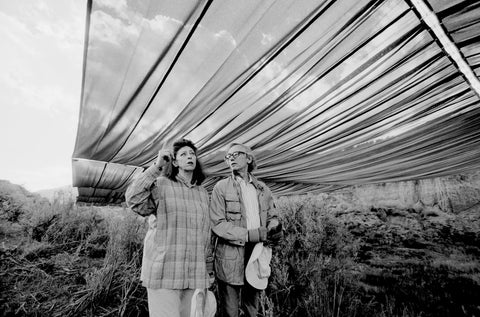
Christo Vladimirov Javacheff was born in Bulgaria in 1935. His French wife and collaborator, Jeanne-Claude Denat de Guillebon, was born on the same day, in the same year, in Casablanca. They met in Paris, moved to New York, and spent the next four decades conceiving projects of a scale that no other artists have seriously attempted before or since.
Their method was deliberate and unhurried. A project might take twenty years from conception to realisation — not because of creative hesitation, but because Christo and Jean-Claude financed everything themselves, accepted no public funding or sponsorship, and navigated every legal, environmental and bureaucratic obstacle entirely on their own terms. The wrapped Reichstag in Berlin took 24 years to realise. The Gates in Central Park took 26.
Jean-Claude died in 2009. Christo continued working alone until his own death in 2020, leaving one final project — L'Arc de Triomphe, Wrapped — to be completed posthumously by his estate, exactly as he had planned.
Over The River: The Project That Never Was
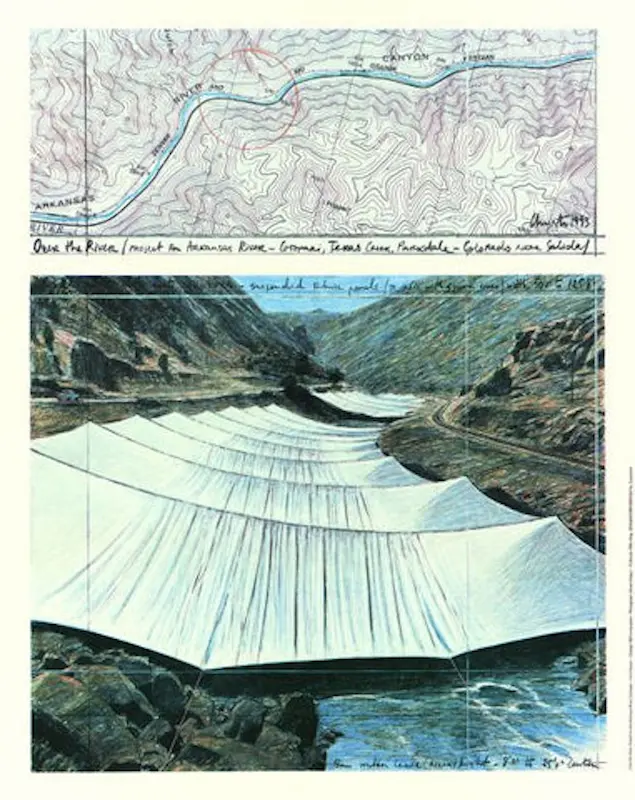
Of all Christo's unrealised works, Over The River, Project for the Arkansas River, State of Colorado is perhaps the most significant. Conceived in the early 1990s, it would have seen silvery fabric panels suspended high above a 42-mile stretch of the Arkansas River — a shimmering ceiling of reflected light and movement for the millions of visitors expected to pass beneath it.
The project received its final federal permit in 2011, following the first Environmental Impact Statement ever completed for a work of art — a 1,686-page analysis usually reserved for infrastructure such as bridges, dams and highways. It was a remarkable moment of institutional recognition.
Then came the lawsuits, a change in administration, and finally Christo's decision to walk away in January 2017, after twenty years of planning and five years of legal proceedings. "I use my own money and my own work and my own plans because I like to be totally free," he said. The federal government had become his landlord. Christo didn't work for landlords.
The prints made in connection with Over The River — preparatory collages, signed lithographs, mixed-media works on paper — now carry particular significance. They document not just a visual concept but a principled act of refusal.
What Makes a Christo Print Worth Collecting?
The editions vary considerably in both form and value. At one end sit unsigned open editions, produced for wider distribution and typically modest in price. At the other are the preparatory collages — works made by Christo's own hand, combining photographs, fabric samples, hand-drawn elements and technical notation — which function as complete artworks in their own right.
Between these sit the signed, numbered lithographs and screen prints produced in limited editions, usually between 50 and 200 examples. These are the works most collectors begin with: authenticated, finite, and connected directly to specific projects.
Jules: Do you think there's something strange about collecting prints from a project that was never built?Avery: Not at all. The idea was always the real work. The fabric was just how he proved it.
How to Buy Christo Prints
The primary market for Christo editions has always been tightly controlled. Works were typically sold through a small number of trusted galleries and directly through the artist's studio. Today, the secondary market — auctions, specialist print dealers, and occasional private sale — is where most collectors will encounter them.
Condition matters significantly with works on paper. Request condition reports, ask about provenance, and look for works accompanied by their original certificates of authenticity. The Christo and Jeanne-Claude Foundation maintains records of authorised editions and can assist with authentication queries.
Are Christo prints a good investment?
The market for Christo's work has strengthened since his death in 2020. Signed, limited editions from major projects — The Umbrellas, Surrounded Islands, The Gates — have seen consistent price appreciation at auction. That said, buying purely for investment is rarely a sound collecting strategy. The more useful question is whether the work means something to you.
How do I know if a Christo print is authentic?
Authentic Christo editions are accompanied by certificates of authenticity and, in many cases, publisher's stamps or gallery documentation. The Christo and Jeanne-Claude Foundation can assist with provenance queries. If buying at auction, request the full provenance history and condition report before bidding.
What is the difference between a lithograph and a preparatory collage?
A lithograph is a print produced in multiples from a prepared stone or plate — Christo typically worked in editions of between 50 and 200. A preparatory collage is a unique work made by hand, combining drawn, photographic and material elements as part of the design process for a specific project. Collages are singular works; lithographs are editions.
Where can I see Christo's work?
Major institutional collections holding Christo's work include the Museum of Modern Art in New York, the Centre Pompidou in Paris, and the Neue Nationalgalerie in Berlin. His final project, L'Arc de Triomphe, Wrapped, was realised in Paris in 2021 and is documented extensively through the Christo and Jeanne-Claude Foundation.
What happened to the Over The River project?
After twenty years of planning and five years of legal proceedings, Christo abandoned the project in January 2017. He cited his unwillingness to work under a federal administration whose values conflicted with his own. The preparatory prints and collages for the project remain in private and institutional collections worldwide.



.webp)
.webp)
%20(2).webp)
.webp)


.png)