



There are objects whose purpose isn’t immediately clear. They sit quietly, angled and structured, almost architectural, as though they belong more to a studio than a cellar. A riddling rack is one of them, and yet without it, Champagne as we know it would not exist.
What problem was riddling designed to solve?
Champagne is not a still wine. It undergoes a second fermentation inside the bottle, where yeast and sugar create both pressure and the bubbles that define it. This transformation, however, leaves behind sediment—a fine residue of spent yeast cells suspended in the wine. For centuries, this meant Champagne was often cloudy, and while producers attempted to clarify it through decanting or filtering, these methods compromised the wine’s character. Clarity, it seemed, came at the expense of sparkle, and the problem persisted until a more elegant solution emerged.
Who invented the riddling rack, and why does it matter?
The story begins with Barbe-Nicole Ponsardin, better known as Veuve Clicquot. Widowed at twenty-seven, she inherited her husband’s Champagne house in 1798 and stepped into a role few women occupied at the time. Faced with the persistent issue of cloudy wine, she worked with her cellar master Antoine Müller to develop a solution. Around 1816, she had a kitchen table cut with angled holes and set at an incline. Bottles placed neck-down in these openings could be rotated incrementally, allowing sediment to gather in the neck. What began as a simple adaptation became the pupitre, and in solving a technical problem, she transformed Champagne into the clear, refined wine we recognize today.
What is a riddling rack and how does it work?
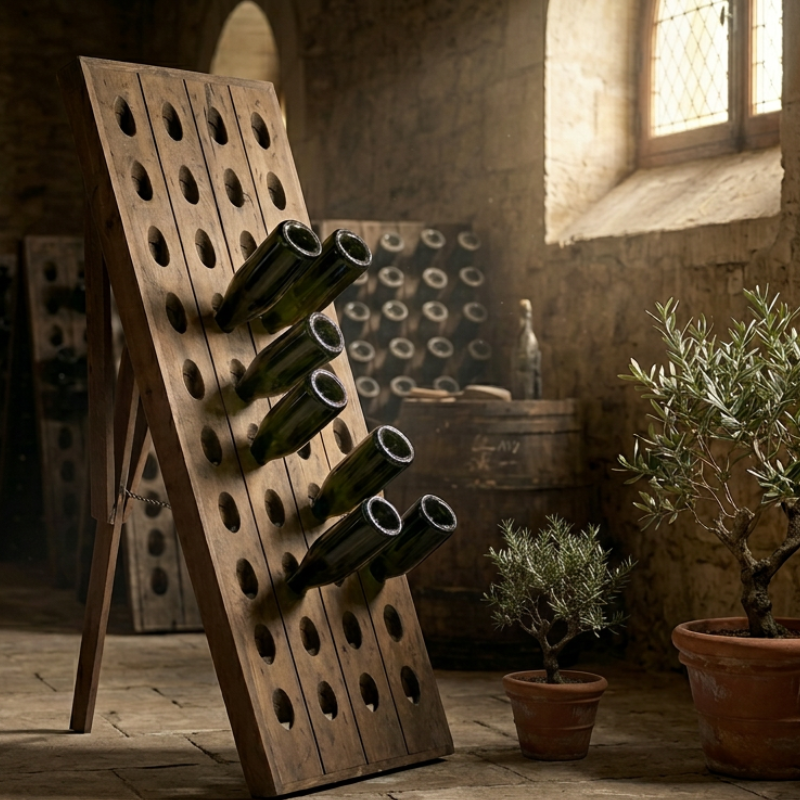
A riddling rack, or pupitre, is a hinged, A-frame wooden stand fitted with angled holes designed to hold Champagne bottles. Bottles are initially placed at a moderate angle and gradually moved toward a near-vertical position, typically around seventy-five degrees. The purpose of this positioning is to guide sediment from the body of the wine into the neck of the bottle.
The process itself, known as riddling or remuage, involves turning each bottle slightly each day while increasing its angle. These small, controlled movements loosen sediment from the glass and encourage it to slide downward. Over a period of four to eight weeks, the sediment consolidates neatly in the neck, allowing it to be removed during dégorgement, when the bottle is opened and the sediment expelled under pressure. The result is a wine that is both brilliantly clear and fully expressive.
Why is riddling considered both craft and technique?
Riddling is a process defined as much by rhythm as by precision. A skilled remueur can turn thousands of bottles in a single day, performing each movement with speed and consistency while maintaining control over angle and rotation. Although the action is repetitive, it requires a practiced hand and an understanding of how sediment behaves within the bottle.
In modern production, many large Champagne houses rely on gyropalettes, which automate the riddling process and significantly reduce the time required. Despite this, hand riddling remains in use for certain wines, particularly prestige cuvées and those produced by smaller growers. The slower, manual approach is often valued not only for tradition but also for the subtle influence it may have on the wine’s final character. It reflects a belief that refinement benefits from time and attention rather than efficiency alone.
How did the riddling rack move from cellar to home?
Although the riddling rack was designed purely as a functional tool, it gradually found a place outside the cellar. Its structure, unchanged from its original form, lends it a sculptural quality that feels equally at home in an interior setting. The repetition of angled openings and the stability of its A-frame design give it a quiet presence, while its purpose remains legible even to those unfamiliar with its history.
As a wine rack, it performs exceptionally well, holding bottles at an ideal angle while allowing labels to remain visible. As an object, it carries its past with it, bridging the gap between utility and design. Its transition into the home reflects a broader appreciation for objects that combine function, history, and form.
What should you look for in a riddling rack?
The quality of a riddling rack lies in its materials and construction. Traditional examples are made from solid hardwoods such as oak, beech, or walnut, chosen for their durability and weight. The holes should be smoothly finished to prevent damage to the glass, and the joinery should be strong enough to ensure stability over time.
Full-scale pupitres typically hold around sixty bottles, while smaller versions designed for domestic use accommodate between twenty-four and forty. Beyond capacity, what distinguishes a well-made rack is its sense of balance and presence. It should feel substantial without being heavy-handed, and considered rather than purely decorative.
Why does the riddling rack still matter today?
The riddling rack remains essential not only as a historical innovation but as a symbol of how careful, incremental processes can lead to remarkable results. Even in an age of automation, it represents a method that values patience and precision. It also endures as an object that carries its story visibly, requiring no explanation to suggest that it once served a meaningful purpose.
In the Jules & Avery Collection
We tend to find objects like this when we are not looking for them. Ours came from a cellar that had long since been emptied, still standing, worn but steady. There was no urgency to acquire it, which is often how we know we should. It now sits as it was intended, holding bottles at an angle that reflects its original purpose, even if that purpose is no longer required.
What does riddling ultimately represent?
Riddling is not defined by speed but by consistency and patience. It is a process built on small, repeated adjustments that gradually bring clarity. The riddling rack, in turn, becomes more than a tool. It is a reminder that refinement often happens quietly, through attention over time rather than sudden transformation.
—
Available through Jules & Avery.
For those who prefer objects with a past and a purpose.
What is the difference between a riddling rack and a regular wine rack?
A regular wine rack stores bottles horizontally to keep corks moist. A riddling rack — or pupitre — holds bottles at an angle, traditionally 75 degrees neck-down, to consolidate sediment toward the cork during champagne production. In a home setting, the pupitre doubles as a wine rack with considerably more visual presence than most horizontal alternatives.
Can you use a riddling rack for all types of wine?
Yes. The pupitre's angled holes are sized for standard 750ml bottles — Champagne, Burgundy, and Bordeaux shapes all fit comfortably. Magnums and 375ml half-bottles require specific sizing, so check the hole diameter before buying. The rack is particularly well-suited to sparkling wines and Champagne, which is fitting given its origins.
How many bottles does a riddling rack hold?
Traditional cellar pupitres hold 60 bottles — 30 per side. Home-scale versions range from 20 to 40 bottles. The Jules & Avery version holds 40 bottles on one side of the A-frame, which is a sensible size for a dining room or kitchen — enough to look deliberate, not so many as to overwhelm the space.
Is a wooden riddling rack better than a metal one?
Wood is the traditional material for a reason: it is stable, forgiving against glass, and improves with age. Oak and beech are the most common choices. Metal riddling racks exist but tend to look more industrial than editorial. If you want the object to earn its place in a room rather than just serve a function, solid hardwood is the only real answer.
Where did the riddling rack originate?
The pupitre was developed around 1816 in the champagne cellars of what would become Veuve Clicquot, credited to Barbe-Nicole Clicquot and her cellar master Antoine Müller. The design — angled holes in a hinged A-frame — has remained essentially unchanged for more than two hundred years. It is one of the more quietly extraordinary examples of a solution so good it required no revision.














.webp)

.webp)


%20(2).webp)
.webp)


.png)