



<h2>What is urban art and why has it become so collectible?</h2>
<p>Urban art encompasses the visual language born on city walls — graffiti, street murals, wheatpaste, stencil work — that has migrated decisively into gallery spaces and serious collections over the past two decades. Artists who once worked without permission on Nolita fire escapes or North Shields railway arches now command significant auction results. The shift happened because the work was always serious; the market simply caught up.</p>
<h2>Who is Prefab77 and what makes his work distinctive?</h2>
<p>Prefab77 is the alias of Peter Manning, a British artist whose biography reads like a brief for his art. Trained as a printmaker and designer in the British Army — where precision is not optional — he later decamped to New York in the early 1990s, living on Elizabeth Street in Nolita during its transitional years: rough-and-ready tenement dwellers on one side, armed-guarded jewellery stores on the other. The layered posters, urgent tags, and incidental beauty of that street became his visual education. Works by Swoon, Faile, and Obey were appearing on the same walls. It was, as he has described it, an epiphany.</p>
<p>Based in Newcastle for more than two decades, Manning has spent that time distilling those experiences into a body of work that is instantly identifiable: hard-edged, stripped down, often allegorical, always beautiful. His imagery orbits gangs, goddesses, and groupies — female portraiture as political act, rendered in acrylic, spray paint, wheatpaste, and varnish. The technique carries the physical memory of printmaking. The subjects carry the weight of power, beauty, and the systems that govern both.</p>
<p>He has worked with Nike, Converse, GAP, and Keds. He produced the cover art for the New York Dolls' final studio album. He has exhibited in Detroit, San Francisco, Ibiza, and London. The career arc is that of an artist who was never underground so much as pre-mainstream — consistently ahead of where taste was heading.</p>
<p><strong>Jules:</strong> It's the restraint that gets you, isn't it. Not what's in the frame — what isn't.</p>
<p><strong>Avery:</strong> He learned that on a wall. You can't be indulgent on a wall.</p>
<p><strong>Jules:</strong> You can't be indulgent at all.</p>
<p><strong>Avery:</strong> And yet here we are, buying art.</p>
<h2>What is the Heavy Crown print and why does it matter?</h2>
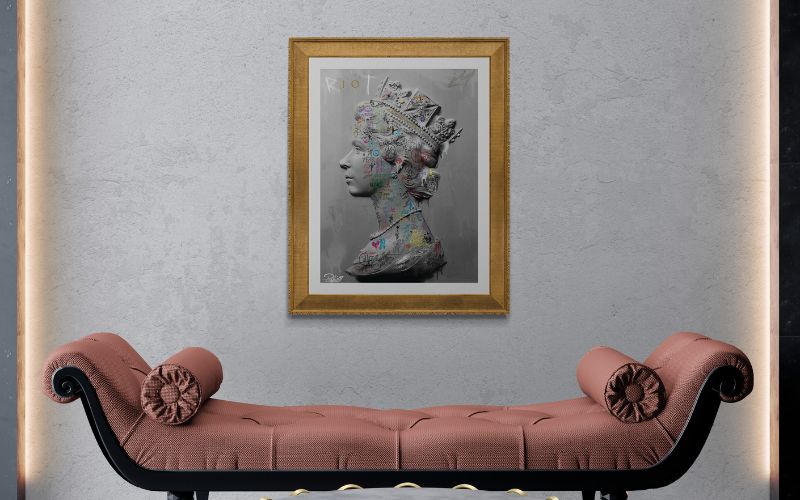
<p>Part of Prefab77's R10T series, <em>Heavy Crown</em> is an archival pigment print on 300gsm Somerset fine art paper — the kind of substrate that serious printmakers choose for a reason. The edition runs to 100, each signed by the artist in white ink and embossed with his stamp. At 56 × 76 cm, it has presence without requiring a wall that can sustain it.</p>
<p>The image is a female portrait, queenly and loaded. The title does what Prefab77 titles always do: it operates on several registers at once. The crown is heavy because power is heavy. The crown is heavy because beauty is burden. The crown is heavy because whoever wears it earned it, and whoever painted it knows the difference between an icon and a cliché. <em>Heavy Crown</em> occupies the space where those two things refuse to become each other.</p>
<p>Somerset paper matters here. It is the paper of choice for editions that are meant to last — museum-grade, acid-free, with a surface that holds archival pigment without softening the edge. This is not a decorative print. It is an edition with the seriousness of a fine art object, which is exactly what it is.</p>
<h2>How does Prefab77 fit into the broader urban art market?</h2>
<p>Urban art as a collectible category has moved from speculative to established. Banksy is the entry-level name; the market beyond him — Swoon, Faile, WK Interact, and, yes, Prefab77 — rewards collectors who understand the lineage. Manning's work sits at the intersection of street credibility and fine art craft: he came up in the same New York milieu as the artists who are now benchmark names, trained with the same rigour, and has continued producing at the same level for over twenty-five years.</p>
<p>Limited editions of 100, on archival paper, signed and stamped — this is the format that serious collectors treat as an entry point into an artist's work before originals become unavailable or unaffordable. The <em>Heavy Crown</em> is available now. That is the relevant information.</p>
<p>The comparison that keeps surfacing — and earns its place — is with Swoon and Faile: artists who emerged from the same New York street culture, developed a distinctive visual language, and built reputations that have only grown. Prefab77 belongs in that conversation. The North of England grounding adds something the New York scene rarely produces: a certain Northern bluntness, an economy of means that reads as authority rather than minimalism.</p>
<h2>What should first-time collectors know before buying urban art prints?</h2>
<p>Edition size matters. An edition of 100 on archival paper from a mid-career artist with a twenty-five-year practice is a different proposition from an open edition print or a reproduction. Look for the artist's signature and numbering, the paper specification, and whether the print is from a defined series — all markers of a print made with collection in mind rather than volume sales.</p>
<p>Condition is straightforward with new editions: store flat, frame with UV-protective glass, keep away from direct light. The Somerset paper in the <em>Heavy Crown</em> is built for longevity; the archival inks will not fade under normal conditions. What you are buying is a thing that was made to last, which is not a given at any price point.</p>
<p>Finally: buy what alters the room. The most reliable indicator that a work will retain value is that you cannot stop looking at it. <em>Heavy Crown</em> has that quality. It is not comfortable art. It is compelling art. The difference is everything.</p>
What is Prefab77's real name and where is he based?
Prefab77 is the alias of Peter Manning, a British artist based in Newcastle, England. His practice spans large-scale street murals and limited-edition fine art prints. Manning trained as a printmaker and designer in the British Army before moving to New York in the early 1990s, where his time in Nolita's street culture became central to his visual language.
Is Prefab77 a solo artist or a collective?
The answer varies by source. Early descriptions position Prefab77 as a collective with roots in the north of England, California, and New York. More recent work is attributed to Peter Manning as a solo practitioner. The core aesthetic — hard-edged, graphic, politically inflected — has remained consistent throughout, which may explain why the distinction matters less than the output.
How much do Prefab77 prints cost?
Entry-level signed screen prints start from around $150 to $400 for standard editions. Hand-embellished multiples and rarer pieces in smaller editions can reach $1,000 or more. Secondary market prices through auction have reached $1,075. Edition size, paper quality, and level of hand-finishing all influence price — smaller editions on heavier art paper command the most.
Where can I buy authentic Prefab77 prints?
Authentic Prefab77 prints are available through specialist urban art platforms including Printed Editions, Artsper, Art of Protest Gallery in York, and 1stDibs. Secondary market works appear at auction via Tate Ward. Always confirm edition details and request a certificate of authenticity. Works accompanied by documentation from the original gallery carry the most transparent provenance.
Is urban art a good investment category?
Urban art has moved from speculative to serious over the past fifteen years. Works by Banksy, Shepard Fairey, and FAILE have seen significant appreciation. For lesser-known but critically respected artists like Prefab77, the investment case rests on edition scarcity, critical recognition, and the quality of the print-making itself. Buying what you would genuinely hang remains the soundest approach.
.jpg)


.png)
.jpg)

.jpg)
.jpg)
.jpg)

.jpg)


.jpg)
.png)




.png)