


.png)
What are Damien Hirst's Beautiful Paintings?
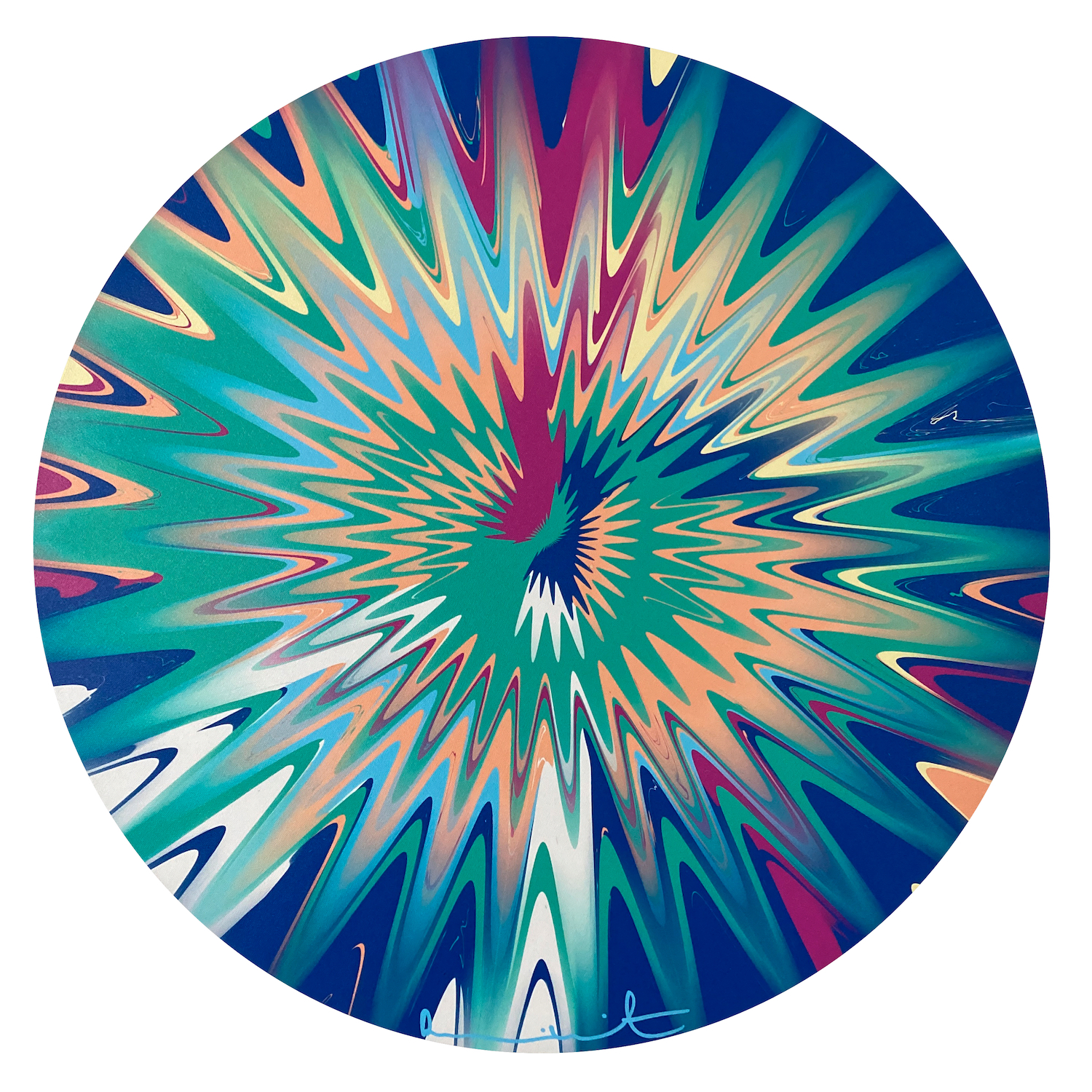
The Beautiful Paintings are a series of unique, AI-generated works by Damien Hirst, produced in collaboration with HENI. Using a generative algorithm trained on over 2,000 of his Spin Paintings, collectors configured colour, style, and format to produce a one-of-a-kind giclée print — hand-signed by Hirst — with a machine-generated title. Jules & Avery are proud to offer two pieces from the edition.
How does the machine learning algorithm behind The Beautiful Paintings work?
The collaboration between Hirst and HENI — the arts and technology company that has become his primary digital partner — began well before the 2023 launch. Over more than a year, Hirst worked with HENI's data science team to build a generative algorithm capable of constructing artworks in 25 unique styles, each reflecting the visual language of his existing Spin Paintings.
The algorithm itself is written in p5.js, a JavaScript library, and stored on-chain. It draws on a combination of techniques — WEBGL shaders, Perlin noise, trigonometric functions — to replicate the centrifugal motion of paint on a spinning surface without any paint, any canvas, or any spinning. The serendipity is preserved; the mechanics are entirely digital.
Before any work was printed, a second algorithm intervened. A generative adversarial network, trained on more than 2,000 of Hirst's physical Spin Paintings, upscaled each output to 16K resolution — fine-grained enough to maintain the intricate detail and painterly texture of the original works at any size, from a 23cm circle to a 100cm canvas.
The titles, too, were machine-generated. Following the existing Spin Painting convention — beginning with 'Beautiful', ending with 'Painting', with a cascade of descriptive language between — the algorithm generated unique, sometimes surreal appellations for each work. Collectors could regenerate a new title for the same image if the first didn't suit. Which raises an interesting question about authorship.
Jules: So Hirst made the algorithm and the algorithm made the painting and the collector made the choices — who actually made it?
Avery: All three. That's the whole point.
Is The Beautiful Paintings series a landmark moment for AI and digital art?
That depends on who you ask — and the answers are sharply divided. For Hirst's supporters, The Beautiful Paintings represent a logical evolution of a practice that has always interrogated the relationship between the artist's hand and the work's meaning. If a painting made on a spin machine at arm's length is still a Damien Hirst, then surely one produced through a generative algorithm trained on his archive carries the same DNA. The process has changed; the sensibility, the eye, the aesthetic vocabulary has not.
For critics, the series raises harder questions. The Beautiful Paintings generated more than $20 million in sales during its ten-day window in April 2023. That commercial success — combined with the language of 'revolutionary' art-making that accompanied the launch — struck some as savvy marketing dressed in the clothes of conceptual innovation. Artnet called it Hirst showing 'an appetite to capitalise on the latest buzzwords of a tech-fuelled art moment: machine learning, generative art, NFTs.'
Both positions have merit. What is undeniable is that Hirst positioned himself ahead of most of his peers in engaging seriously with generative AI as a creative tool — not merely dabbling, but spending over a year developing the underlying algorithm. The work sits at a genuinely contested frontier: what does authorship mean when the artist defines the system, the collector configures the variables, and the machine produces the output? The Beautiful Paintings don't answer that question. They dramatise it.
What makes the Jules & Avery editions worth collecting?
The two pieces offered through Jules & Avery are giclée prints on poly-cotton artist canvas, mounted on birch plywood stretchers — the same specification as every physical work from the edition. Each is unique: no two Beautiful Paintings are alike, the result of the same element of controlled randomness that has defined the Spin Paintings since 1992.
Both are hand-signed by Hirst in paint pen on the front of the canvas — a physical mark that anchors the digital process in the tradition of the artist's hand. In an edition where the algorithm generates the image, the signature matters more, not less.
What are Damien Hirst's Beautiful Paintings?
The Beautiful Paintings are a series of unique AI-generated artworks produced in 2023 in collaboration with HENI. Using a generative algorithm trained on over 2,000 of Hirst's Spin Paintings, collectors configured their own piece by choosing colours, style, size, and shape. Each work was produced as a giclée print on canvas, hand-signed by Hirst, with a unique machine-generated title. The edition ran for ten days only, in March and April 2023.
Are Damien Hirst's Beautiful Paintings a good investment?
Hirst's market remains strong, and works from The Beautiful Paintings carry several hallmarks of collectible value: they are unique (no two are identical), hand-signed, from a timed and now-closed edition, and produced at a moment of genuine significance in the conversation around AI and art. As with any contemporary work, value depends on condition, size, and how the broader market views Hirst's digital output over time. The series generated over $20 million in ten days — that level of demand is rarely without consequence.
How is a Damien Hirst Spin Painting different from The Beautiful Paintings?
Traditional Spin Paintings were made by attaching a canvas to a rotating machine and applying paint directly — a physical, chance-driven process. The Beautiful Paintings replicate the visual logic of that process using a generative algorithm and machine learning, without any physical paint or spinning. The output is a giclée print rather than a painted canvas, but the aesthetic language — centrifugal arcs, vibrating colour fields, long descriptive titles — is continuous with the original series. Hirst has called the two bodies of work part of the same conversation.
Is Damien Hirst considered a pioneer of AI art?
He is among the first major blue-chip artists to build and release a generative AI system as the primary vehicle for a significant commercial edition. While artists like Beeple and Refik Anadol had been working in digital and generative art for longer, Hirst brought that conversation to a mainstream contemporary art audience. His use of a generative adversarial network trained on his own archive — rather than a generic AI tool — gave the project genuine technical specificity that separated it from more superficial AI experiments.
Can I still buy works from The Beautiful Paintings?
The original edition window closed on 10 April 2023. Works now appear through secondary market dealers and specialist print galleries. Jules & Avery currently hold two pieces from the edition — both unique, hand-signed giclée prints on canvas. These are available now via the links in this article.
What does Damien Hirst's signature in paint pen mean for the value of a Beautiful Painting?
Each physical work from The Beautiful Paintings is hand-signed by Hirst on the front of the canvas in paint pen — not on a certificate, not on the verso, but on the face of the work itself. In an algorithmically generated edition, this physical intervention by the artist carries particular weight. It is the one element of the work that cannot be replicated by the system: the mark that is irreducibly his.

.jpg)








.webp)
.webp)

%20(2).webp)
.webp)


.png)