


Where did the Michelin Man come from originally?
The origin story begins, improbably, at a trade exhibition in Lyon in 1894. Édouard Michelin noticed a stack of tires displayed at his company's stand and remarked, offhandedly, that if they had arms, the pile might resemble a man. The image lodged. Four years later, at another exhibition in Brussels, his brother André encountered a similar display — and remembered the remark.
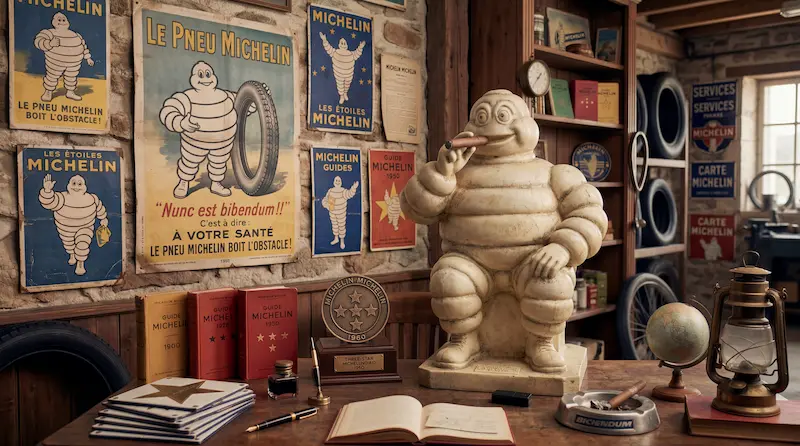
The brothers commissioned Marius Rossillon, a celebrated poster artist who worked under the name O'Galop, to create a figure. The first poster appeared in 1898. It showed a vast, pale, tire-stacked man raising a foaming glass — the liquid inside scattered with nails, broken glass, and road debris. Above him: the Latin phrase Nunc est bibendum, from Horace's Odes. "Now is the time to drink." The implication was that Michelin tires devoured obstacles the way a confident drinker dispatches champagne.
He was called Bibendum from the first day.
What did the original Bibendum actually look like?
The early Bibendum bears only a passing resemblance to the figure on your tire receipt today. He was enormous — a puffed, Edwardian giant, pale and vaguely unnerving, with a cigar clamped between his lips and a manner that suggested he had recently swallowed something. The tires of the period were white or pale gray (carbon black was not added until around 1915, when it was discovered to increase durability), which explains the ghostly coloring that has since become so familiar.
He wore a pince-nez in some early iterations. He smoked regularly. He drank. He was — by the standards of what a brand character is now permitted to be — magnificently unconcerned with his health.
The cigars were eventually retired in the 1960s. The pince-nez vanished rather earlier. With each decade, Bibendum became somewhat less intimidating and somewhat more approachable — a trajectory familiar to anyone who has watched a luxury brand try to go mass-market without losing its nerve.
How the Michelin Guide changed everything
The guide came first as a practical object, not a cultural institution. In 1900, André Michelin produced a small red book for French motorists — maps, fuel stations, tire-change instructions, a list of hotels and restaurants where a traveler might stop. The logic was commercial and entirely unsentimental: more people driving meant more tires worn down, more tires sold. The guide was a tool to sell rubber.
It was given away free until 1920, when André, discovering copies being used to prop up a workbench in a garage, declared that people only value what they pay for. He was right, and the price went up.
The restaurant stars arrived in 1926 — a single star, initially, for notable establishments. The three-tier system we know now appeared in 1931. What began as a motorist's companion had become, quietly and without anyone fully intending it, the most consequential document in the history of professional cooking.
Bibendum watched all of this from the cover and the margins — the mascot of an empire that had expanded far beyond his original remit.
VISIT: The Online Michelin Guide
Why Bibendum endures when other mascots don't
Most brand mascots of the late 19th century are gone. They were products of their moment — illustration styles that dated, personalities that curdled, associations that became liabilities. Bibendum survived because his construction is a genuine idea, not a decoration.
He is the product. That is unusual. Most mascots are adjacent to the product — a tiger selling cereal, a gecko selling insurance. Bibendum is literally assembled from what Michelin makes. There is no gap between the symbol and the thing being sold. This gives him a material honesty that no amount of rebranding can erode.
He was also updated consistently rather than replaced — the body proportions adjusted, the expression softened, the tires made rounder and less menacing — so there is no abrupt discontinuity in the archive. He has aged the way a good building ages: renovated, not demolished.
VISIT: BIBimage Gallery: Images and advertisements of the Michelin Man
What does Bibendum mean for the brand today?
Michelin operates in a curious double life. On one side: tires, the Formula One circuit, the aeronautics industry, precision engineering. On the other: restaurant guides, hotel recommendations, the slow drama of a chef waiting to hear whether a star has been added or taken away. Bibendum bridges these two worlds — jovial enough for the dining room, industrial enough for the garage — without obviously belonging to either.
That tension is, arguably, the brand's greatest asset. It is why a company that makes tires can credibly end a chef's career.
Who invented the Michelin Man?
The figure was created by poster artist Marius Rossillon, known professionally as O'Galop, and commissioned by the Michelin brothers — André and Édouard — following a moment of inspiration at a trade exhibition in Lyon in 1894. The first poster appeared in 1898.
Why is the Michelin Man called Bibendum?
The name comes from the Latin phrase Nunc est bibendum — "Now is the time to drink" — taken from an ode by Horace. The original 1898 poster showed Bibendum raising a glass filled with road hazards, implying that Michelin tires consumed obstacles as readily as a drinker dispatches champagne.
Why was the original Michelin Man white?
Early automobile tires were made from natural rubber, which is pale or off-white. Carbon black — which turns tires dark gray and significantly increases their durability and wear resistance — was not widely adopted until around 1915. Bibendum's pale coloring is simply an accurate reflection of what the product looked like.
How has the Michelin Man changed over the years?
He has changed substantially. The original Bibendum was larger, paler, and more physically imposing — he smoked cigars, wore a pince-nez, and had an Edwardian grandeur that modern brand sensibility would find difficult to manage. Over the 20th century he was gradually slimmed down, softened in expression, and made more approachable, with the cigars disappearing in the 1960s. The core silhouette — a figure built from stacked rings — has remained constant.
What is the connection between Michelin tires and the Michelin restaurant stars?
André Michelin produced the first Michelin Guide in 1900 as a practical resource for motorists — fuel stations, garages, hotels, restaurants. The commercial logic was direct: encourage driving, sell more tires. Restaurant stars were introduced in 1926 and expanded to the three-star system in 1931. What began as a promotional tool for a tire company became the defining institution of fine dining. Bibendum has presided over both sides of the operation from the beginning.





.webp)

.webp)
%20(2).webp)
.webp)


.png)