



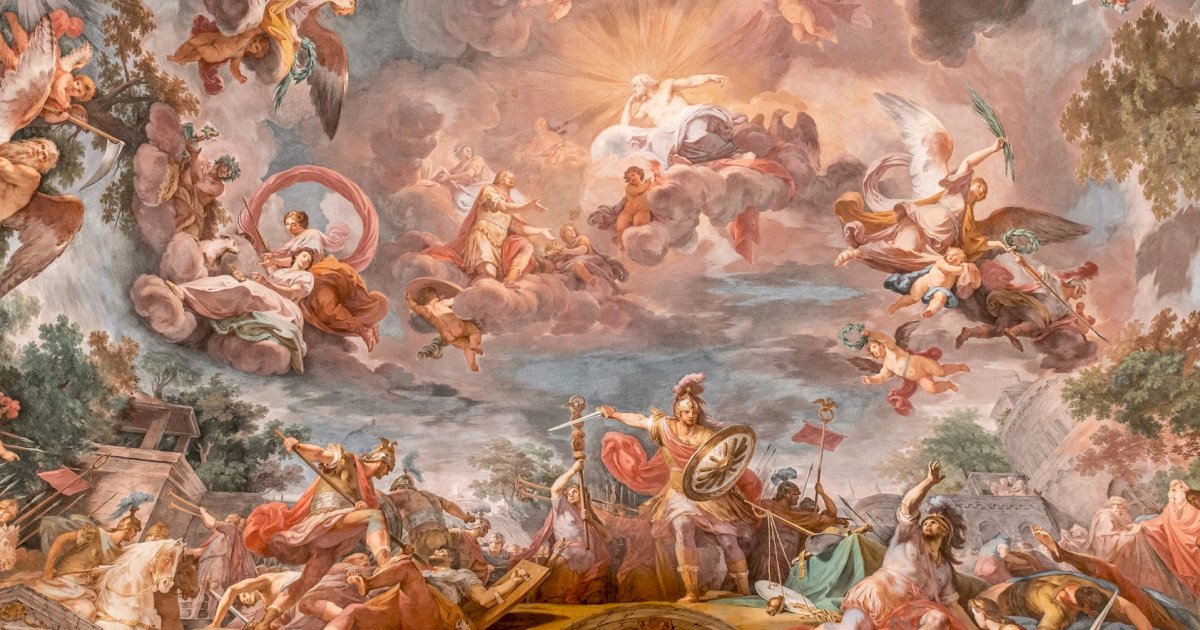
Before we get to the rooms themselves, a little context — because fresco painting is not a medium for the impatient or the faint-hearted, and understanding what it demands makes you love it all the more.
A Brief History of the Masterpiece Fresco
The word fresco comes from the Italian for "fresh," and that is precisely the point. True fresco — buon fresco — requires the artist to apply pigment directly onto wet plaster. There is no going back, no overpainting, no second chances. The plaster dries, the pigment is locked in, and the image becomes part of the wall — or, in our case, the ceiling — forever. The technique traces its roots to ancient Minoan and Roman civilizations, but it reached its most celebrated heights during the Italian Renaissance and Baroque periods.
Michelangelo's Sistine Chapel ceiling, completed in 1512, is the obvious touchstone. But the tradition of ceiling fresco extended far beyond the Vatican. Cardinals, princes, and papal families commissioned painters to transform their private homes into temples of mythology and power. The Borghese family — one of Rome's great collecting dynasties — was no exception. The Villa Borghese, built in the early 17th century as a summer residence for Cardinal Scipione Borghese, was designed from the very beginning as a showcase. Not just for sculpture and canvas, but for the rooms themselves.
The ceilings you see today span nearly two centuries of work, from the grand Baroque sweep of Giovanni Lanfranco to the neoclassical elegance of the late 18th century. Each one tells a story. Each one rewards the cricked neck.
1. The Great Hall — The Council of the Gods by Giovanni Lanfranco
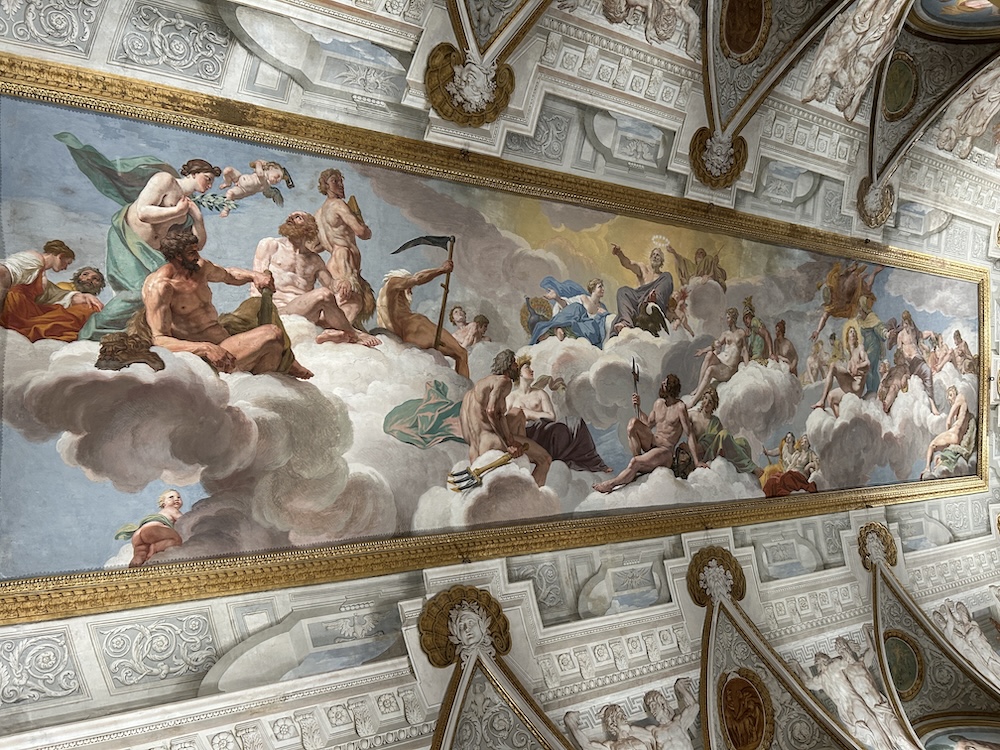
If you enter the Galleria Borghese and do nothing else, walk into the Great Hall and stop. Look up. Giovanni Lanfranco's The Council of the Gods is the kind of ceiling that makes you understand why Baroque painters were considered something close to magicians. Lanfranco, a master of dramatic illusionism, fills the vault with a swirling assembly of Olympian deities rendered in the kind of saturated, confident color that only buon fresco at its finest can achieve. Figures seem to spill over the edges of their architectural frames, reaching down into the room itself. It sets the tone for everything that follows.
2. Room 2 — The Fall of Phaeton by Francesco Caccianiga
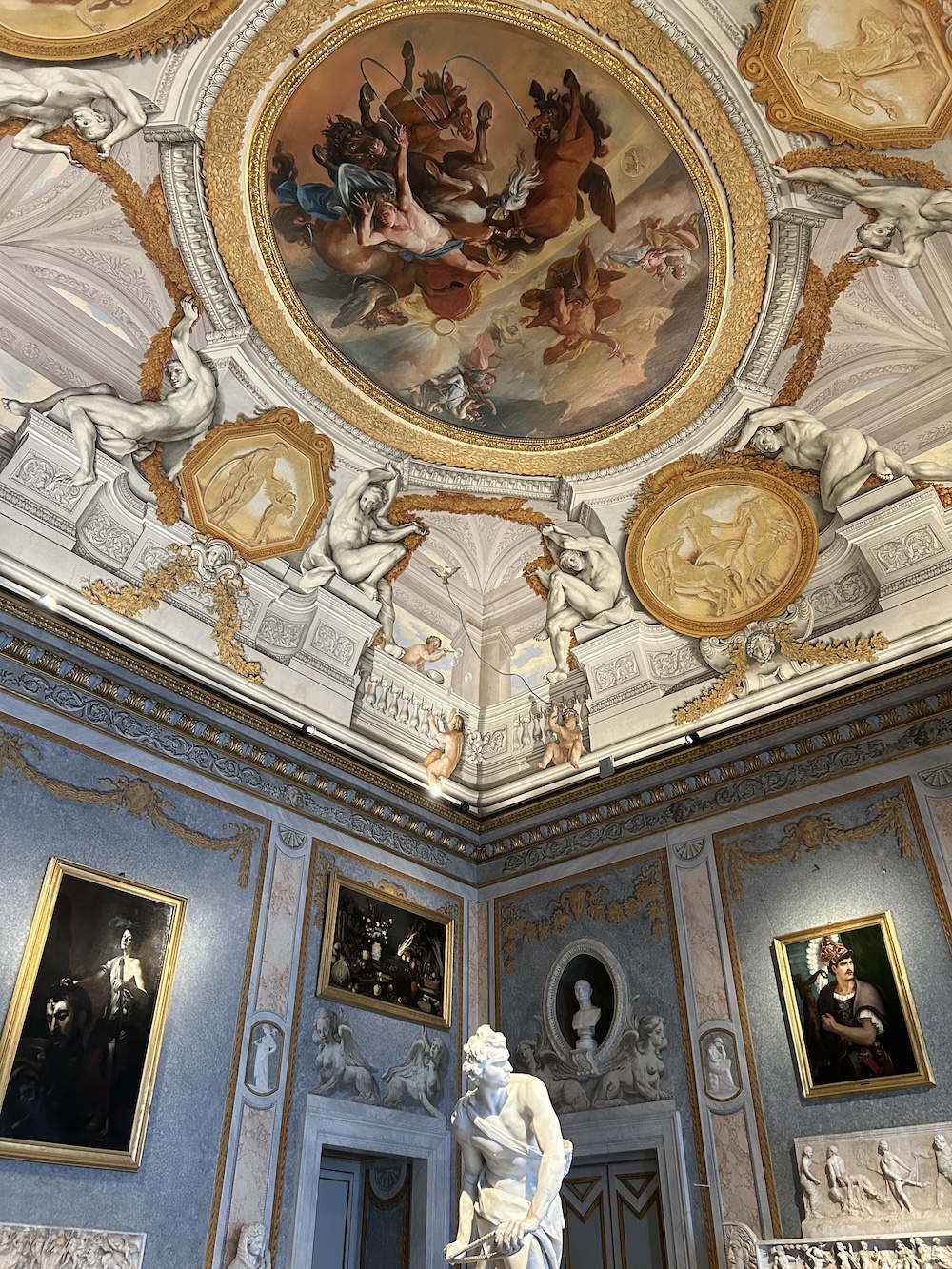
The Room of the Sun earns its name. Francesco Caccianiga painted The Fall of Phaeton between 1775 and 1777, and the choice of subject is almost too perfect for a ceiling. The myth, of course, is this: Phaeton, son of the sun god Helios, begs to drive his father's chariot across the sky. He loses control. Zeus strikes him down with a thunderbolt to prevent the earth from burning. It is a story about hubris, about the terror of the sun, and Caccianiga paints it overhead with a neoclassical precision that makes the drama feel almost architectural.
Below this ceiling stands Bernini's David, carved in 1623–1624 when Bernini was barely in his mid-twenties. The sculpture captures the moment just before the stone is released — David's whole body coiled, his face set with an expression of fierce concentration. It is one of the most psychologically alive pieces of marble ever made. The combination of Bernini's earthbound tension below and Caccianiga's celestial catastrophe above creates a room of extraordinary dramatic charge.
3. The Mariano Rossi Room — The Apotheosis of Romulus
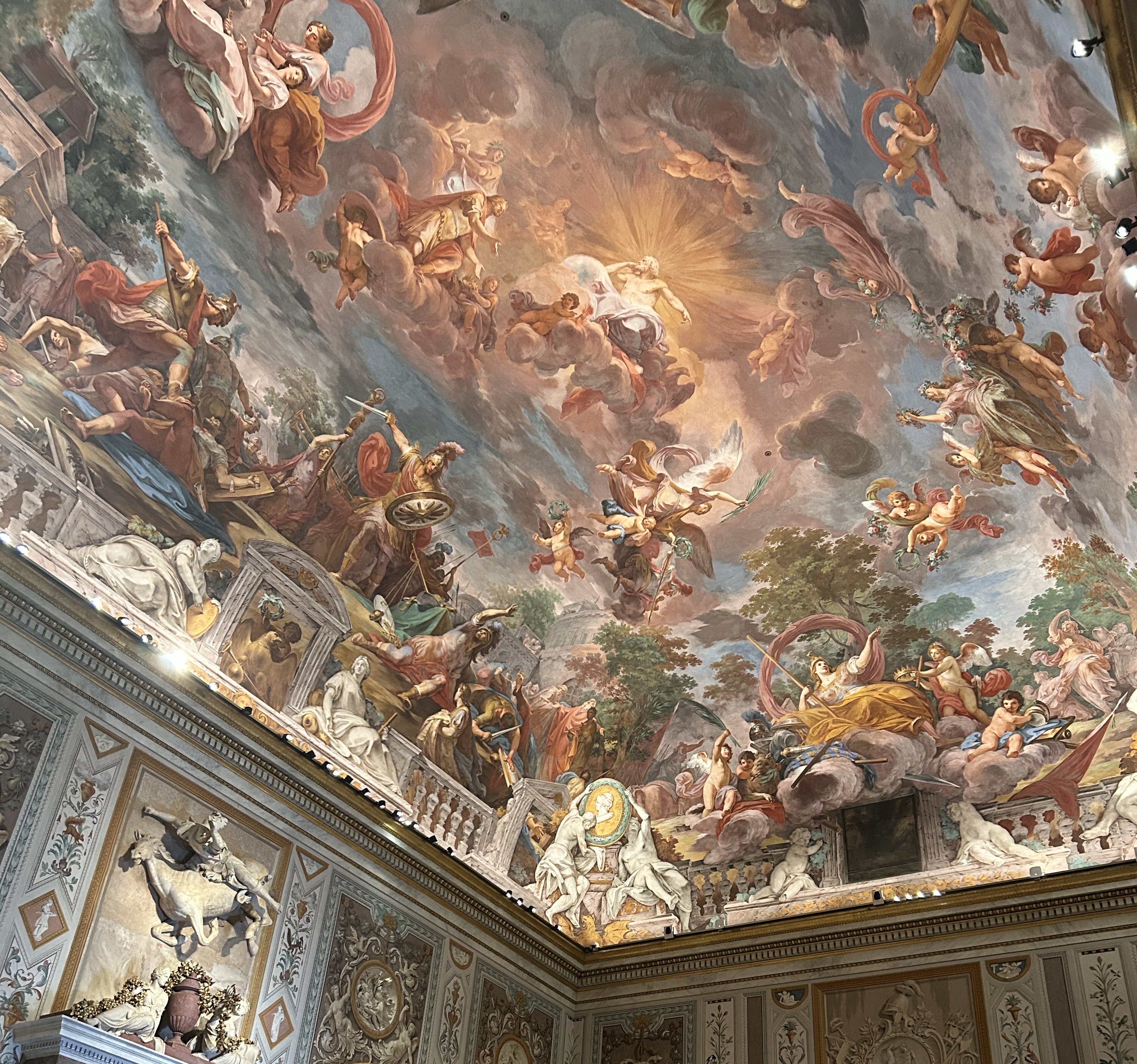
Mariano Rossi was the kind of painter the late 18th century adored: technically accomplished, classically literate, and deeply comfortable with scale. His ceiling for this room, The Apotheosis of Romulus, depicts the legendary founder of Rome ascending to divine status — mortal becoming immortal, flesh dissolving into myth. It is grand subject matter handled with a painter's genuine confidence.
That trust is visible in every square foot of the composition. Rossi understood that a great ceiling fresco is not a wall painting rotated ninety degrees. It is its own visual logic entirely, designed for a viewer standing below, turning slowly, taking it in piece by piece.
4. Room 4 — The Room of the Emperors, Fresco by Domenico de Angelis

Domenico de Angelis completed the ceiling fresco for the Room of the Emperors between 1778 and 1780, and the classical theme feels entirely in keeping with the room's name. De Angelis works in the neoclassical mode with careful, measured brushwork — allegory and imperial imagery rendered with the kind of restraint that characterizes the best painting of its era. Where Lanfranco swirls and surges, de Angelis organizes and clarifies.
It is worth noting what shares the floor of this room: Bernini's The Rape of Persephone, completed in 1622. Carved when Bernini was just twenty-three years old, it depicts the god Pluto seizing Persephone and dragging her into the underworld. The marble is almost physically impossible to believe — Pluto's fingers pressing into Persephone's thigh, her tears, the three-headed Cerberus at their feet. To look up at de Angelis's composed, ordered ceiling and then down at Bernini's catastrophic marble is to understand the full emotional range of this building in a single room.
5. The Apollo and Daphne Room — Ceiling Painting by Pietro Angeletti
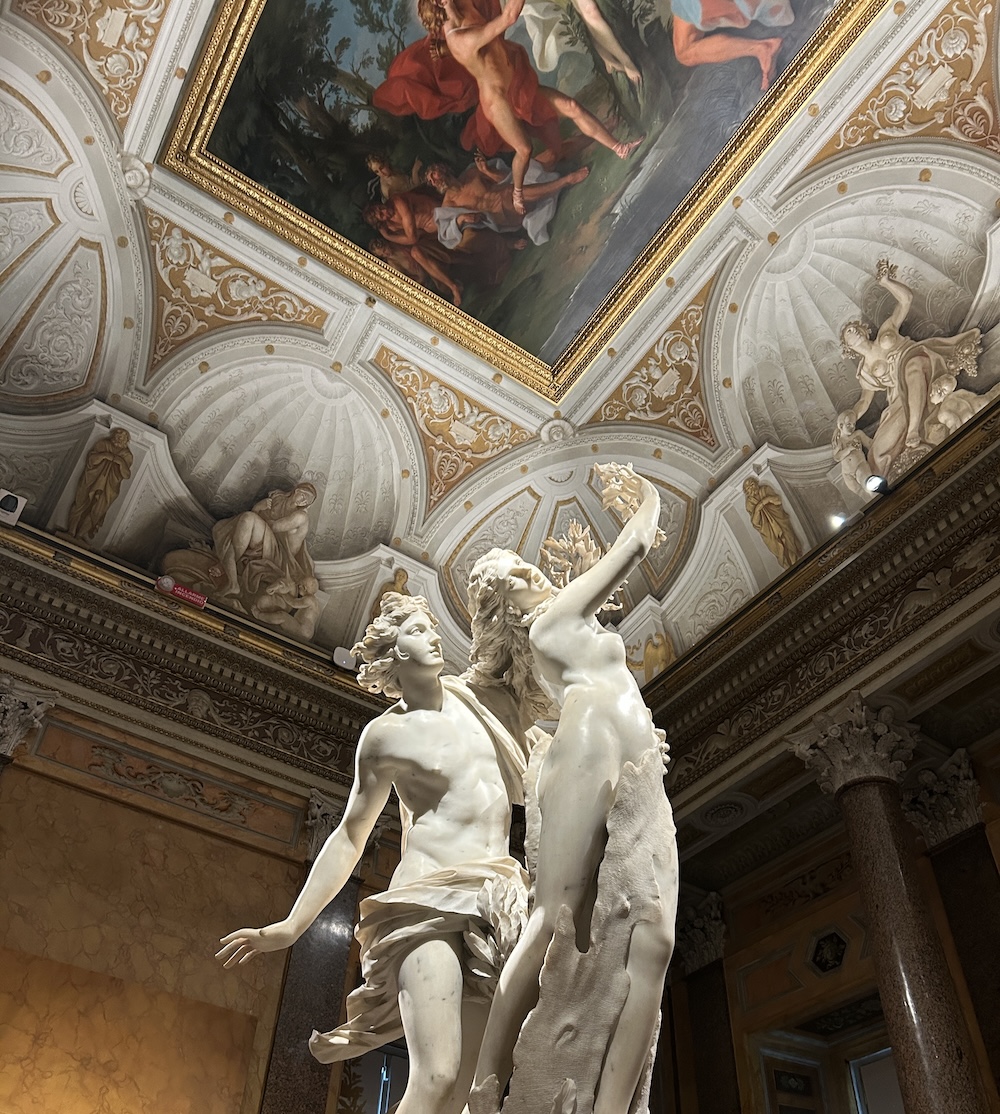
Save this room for last if you can. Pietro Angeletti's ceiling painting occupies the center of the vault and depicts different moments from the tale of Apollo and Daphne as told in Ovid's Metamorphoses — the god's obsessive pursuit, Daphne's desperate prayer, the moment of transformation as she becomes a laurel tree. Angeletti unfolds the myth sequentially, giving the viewer the sensation of reading a story overhead, episode by episode.
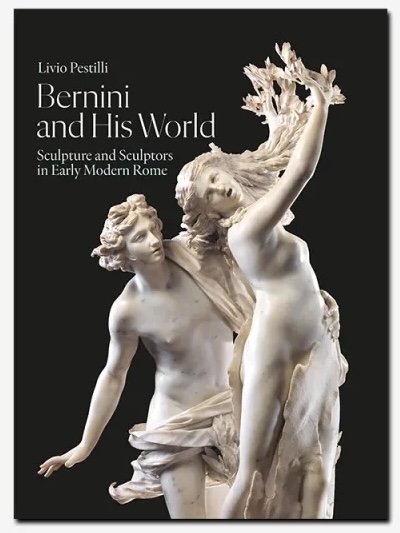
It is an elegant structural choice, and it creates a remarkable dialogue with what waits below: Bernini's Apollo and Daphne, arguably the most breathtaking sculpture in the entire building. Bernini captures the precise instant of transformation — Apollo's hand touching Daphne's skin as bark begins to form beneath his fingers, her hair already becoming branches, her feet roots. Looking up at Angeletti's narrative sweep and then down at Bernini's frozen single moment creates a kind of double vision. The ceiling tells the whole story. The marble tells one second of it. Together, they tell everything.
Why the Ceilings Matter
The Galleria Borghese is one of those rare places where the art and the architecture are in genuine, sustained conversation. The frescoes overhead are not decorative afterthoughts. They were commissioned with intention, chosen to amplify the themes of the rooms below, to frame the sculptures and paintings at eye level in a larger mythological and political narrative. To see only what is in front of you is to see only half the picture.
Next time — and there must be a next time — arrive early, book your timed entry, and spend the first five minutes in every room simply looking up. The ceilings of the Galleria Borghese are among the most beautiful painted surfaces in Rome. They have been waiting, very patiently, for you to notice.
Do I need to book tickets to the Galleria Borghese in advance?
Yes — and this is non-negotiable. The Galleria Borghese operates on a strict timed-entry system with a maximum of 360 visitors per two-hour slot. Tickets regularly sell out weeks in advance, particularly during peak season. Book directly through the official Galleria Borghese website or through an authorized ticket agency well ahead of your visit.
How long should I spend in the Galleria Borghese?
Your entry is limited to two hours, which is enough time to move through all the rooms thoughtfully — provided you resist the urge to linger too long in front of every Caravaggio. Two hours is actually a generous constraint; it forces a pleasing focus. Arrive with a loose plan, but leave room to be surprised.
Is photography allowed inside the Galleria Borghese?
Photography for personal, non-commercial use is generally permitted without flash. The ceilings, in particular, are worth photographing — though no image will quite capture the experience of standing beneath them in person. Always check current guidelines at the time of your visit, as policies can vary.
What is the best time of year to visit the Galleria Borghese?
Spring and fall offer the most pleasant conditions — mild temperatures, good light in the surrounding gardens, and slightly smaller crowds than the height of summer. That said, the Galleria Borghese is a year-round destination. Winter visits have their own quiet appeal, with the gardens stark and beautiful and the interiors feeling even more intimate.
Are there guided tours available at the Galleria Borghese?
Yes. Audio guides are available for rent, and private guided tours can be arranged in advance. A knowledgeable guide adds genuine depth to the experience — particularly for the ceiling frescoes, which often go uncommented upon in standard audio tour formats. Look for specialists in Baroque art or Roman history for the most rewarding experience.
Where is the Galleria Borghese located, and how do I get there?
The Galleria Borghese sits within the Villa Borghese gardens in Rome, a short walk from the Via Veneto and easily accessible by taxi, rideshare, or bus. The walk through the gardens from the Flaminio metro stop is lovely in good weather — about fifteen minutes through one of Rome's most beautiful green spaces, which makes for a fine way to arrive.







.webp)

.webp)
%20(2).webp)
.webp)


.png)