



%20(2).webp)
What does it mean to really understand an object? Not to own it. Not even to admire it — anyone can do that. To understand an object is to know where it came from, who made it, what it cost them, and what it survived. That belief has taken us to auction houses and estate sales and flea markets at unreasonable hours. This time, it is taking us to Italy. We will not reveal the full itinerary yet. But there are two places we can share — two points on the map where the history of making is so concentrated, so alive, that simply standing in them feels like an education.
Check out: Ten Books that Capture the Art of Living the Italian Way
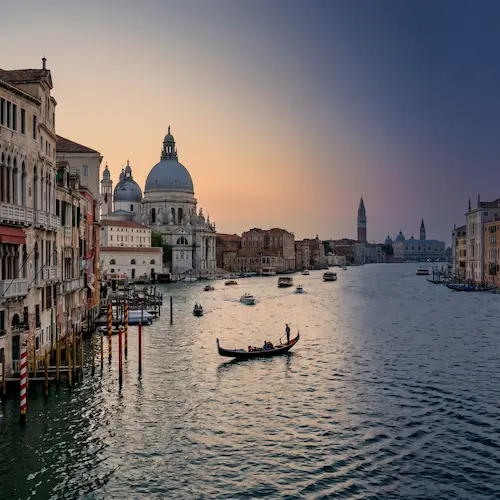
Murano, Venice
The island has been making glass since 1291. The Venetian Republic moved its glassmakers there to protect the city from fire, and then kept the techniques so closely guarded that leaving the island was considered a crime. For a glassmaker to defect was to betray the Republic. The punishment was, in some cases, death.Seven centuries later, the furnaces are still going.We have been buying, selling, and appraising Venetian and Murano glass for years — assessing condition, reading provenance, watching how the light moves through a piece. But knowledge gathered at a desk or across a dealer's table only goes so far. To understand what you are handling, you need to understand how it was made.So we are going to Murano to tour the factories. To watch the gather pulled from the furnace, the breath that shapes it, the tools that have not changed in their essentials for centuries. And — because we believe that to truly appreciate art you need to roll up your sleeves — we are taking a glass blowing class.
There is a particular humility that comes from trying to make something well and failing. It changes how you look at the objects that survive. It changes what you are willing to pay for them, and what you are willing to say about them.
Check out: What to pack | Luxury Essentials for Venice and Rome
Via dei Coronari, Rome
Running west from Piazza Navona, Via dei Coronari has been the heart of Rome's antiques trade since the Renaissance. The name comes from the vendors of rosaries and religious objects who once lined it — pilgrims passed this way on their route to St Peter's, and the street has been in the business of beautiful things ever since.The dealers here are specialists. They are not generalists hedging across categories; they know their furniture, their silver, their paintings, their particular centuries. They will talk to you about their things at length, and that conversation — the provenance they can recite, the restoration history they know intimately, the comparable pieces they have handled — is genuinely part of the experience. Some of the best education in this field happens not in museums but in these rooms, between these people, over an espresso neither of you quite intended to sit down for.
We are going in anticipation of finding objects that are beautiful, masterfully executed, full of patina and rich with history. We are going to look carefully and ask good questions and understand, as deeply as we can, what we are looking at. Whether anything comes home with us is, at this point, entirely theoretical.The rest of the itinerary we are keeping close for now. Not as a tease, but because some things deserve their own introduction. Watch this space.
Is Murano glass still made by hand?
Yes — the furnaces on the island of Murano operate today much as they have for centuries. The core techniques of gathering, blowing, and shaping molten glass remain hand-led, passed down through family workshops. While some studios have modernised elements of the process, the finest Murano glass is still produced by maestros who have trained for decades. It is one of the few living craft traditions with an unbroken lineage going back to the thirteenth century.
Can you visit Murano glass factories as a tourist?
Many of the island's studios offer guided factory tours and demonstrations, and several run glass blowing classes for visitors. Booking in advance is advisable, particularly in summer. Quality varies significantly across studios — look for smaller, family-run operations rather than the larger tourist-facing showrooms near the vaporetto landing. The experience of watching glass being made, and attempting it yourself, is worth the trip across the lagoon.
What makes Via dei Coronari different from other antiques streets in Rome?
Via dei Coronari has been at the centre of Rome's antiques trade since the Renaissance, and its dealers tend to be specialists rather than generalists. The street has a reputation for serious furniture, silver, paintings, and decorative objects from the sixteenth to nineteenth centuries. The dealers are knowledgeable and willing to talk — the conversation is part of the experience, and you will often learn as much from a visit as you would from an afternoon in a museum.
What should I look for when buying antique glass?
Condition is the first consideration — check for chips, cracks, and repairs, particularly around the rim and base. Provenance matters: any documentation of origin or history adds value and confidence. For Murano glass specifically, look for the Vetro Artistico Murano trademark on contemporary pieces; for older pieces, the quality of the workmanship — the fineness of the detail, the clarity or deliberate complexity of the colour — is the most reliable guide. When in doubt, buy from dealers who can explain what they are selling.


.webp)

.webp)

.webp)

.webp)
.webp)


.webp)




.png)