


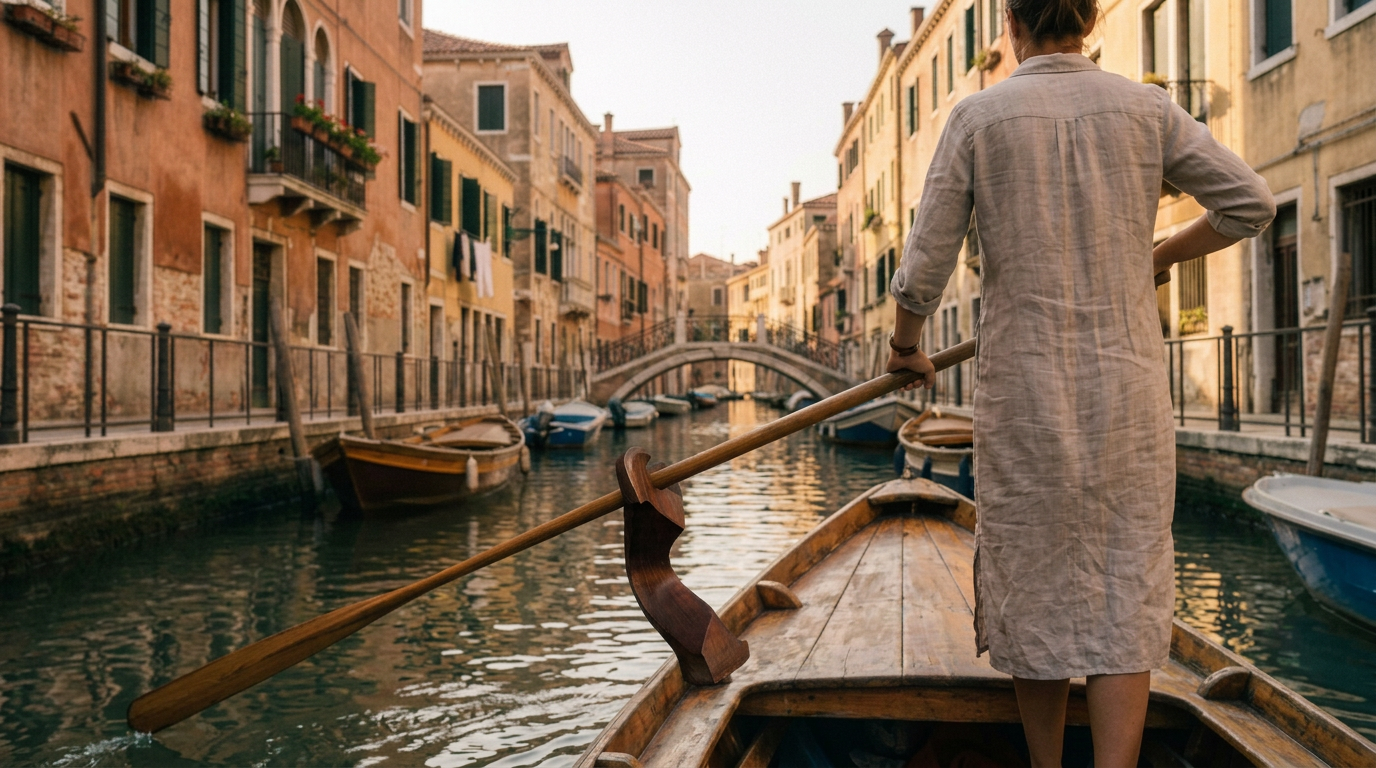
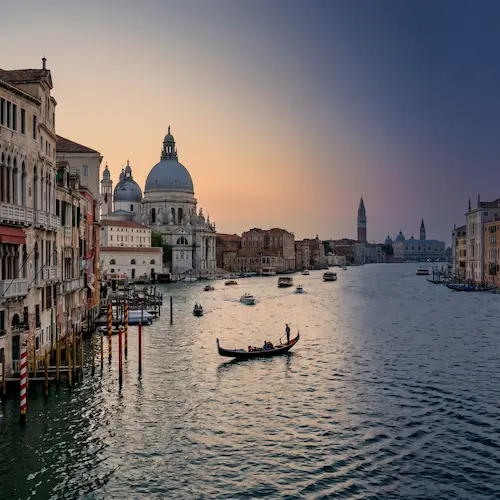
Venice has been rowed for over a thousand years. Long before outboard motors, long before the cruise ships that now send their wakes slapping against palazzo foundations, the city moved by oar. Most visitors experience this legacy as spectators — watched from a bridge, photographed from a fondamenta. We wanted something closer to the original arrangement.
What Exactly Is a Batella?

The batella is one of Venice's oldest traditional working boats, and the reason you don't see many of them anymore is quietly fascinating. Unlike the gondola — which has a distinctive asymmetrical hull designed to compensate for the push of a single oar — the batella is pointed at both ends. A graceful, symmetrical silhouette that looks, from the right angle, almost like a leaf on the water.
That double-pointed shape is precisely why the batella became rare. When motorized boats arrived and reshaped Venetian life in the twentieth century, almost every traditional vessel was retrofitted with an engine. The batella couldn't be. A motor requires a flat stern to mount against; the batella's tapered rear made that impossible. So while flat-bottomed boats got engines and stayed relevant, the batella was quietly left behind — preserved now mostly by enthusiasts, historians, and organizations like Row Venice who understand that some things are worth keeping exactly as they are.
Row Venice and Why an All-Female Team Matters
We'd booked the Squero e Cicchetto experience through Row Venice, and before we even touched an oar, something about the setup was worth noting. The team is entirely female. In a city where gondoliers are overwhelmingly male — a tradition so entrenched that the first licensed female gondolier only appeared in 2010 — Row Venice has built something genuinely countercultural. Our instructor moved across the water with a calm authority that made the whole enterprise feel less like a tourist activity and more like an apprenticeship. https://rowvenice.org/
The Technique: Harder Than It Looks, Better Than You'd Expect
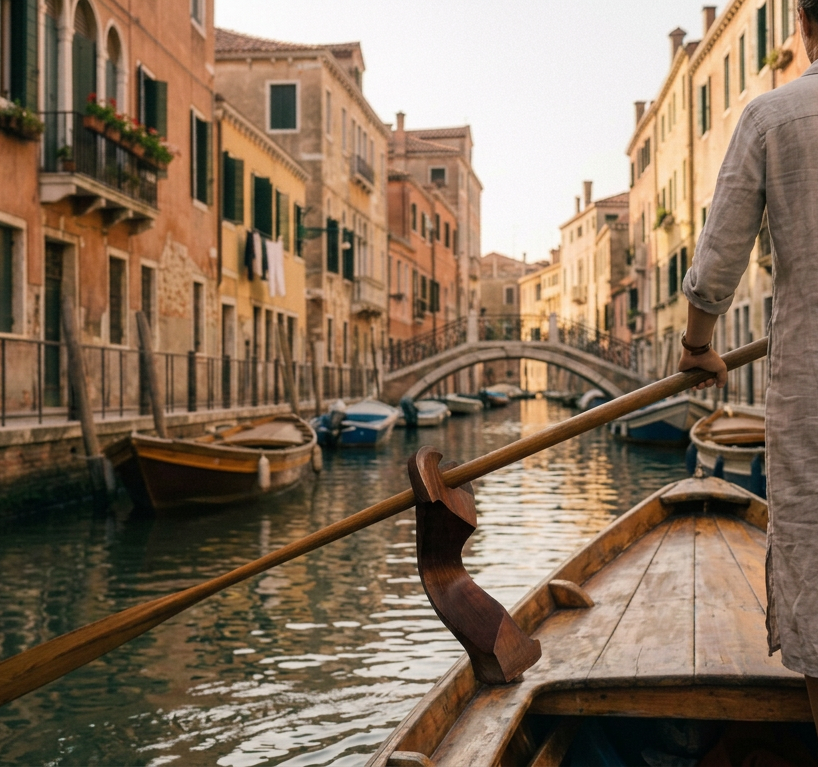
Voga alla Veneta — the Venetian style of standing rowing — is not intuitive. You stand facing forward, which already feels wrong to anyone who has rowed a dinghy or a racing shell. The oar rests in a curved wooden oarlock called a fórcola, a sculptural object in its own right, carved to allow a surprisingly wide vocabulary of strokes. Push, drag, feather, steer. Each movement has a name and a logic.
The first few minutes felt like trying to write with your non-dominant hand. The oar wanted to do its own thing. The boat drifted. We overcorrected. But the technique begins to settle faster than you'd expect — there's a rhythm underneath it all, and once you find it, the sensation of moving a wooden boat through still water under your own power is genuinely, unexpectedly satisfying.
We rowed through a part of Venice most visitors never see: quieter residential canals away from the San Marco crowds, where laundry hangs between upper windows and cats occupy the best spots on every doorstep. Part of this area includes the Jewish Ghetto — one of the oldest in Europe, established in 1516 — where the canals narrow and the buildings rise unusually tall, a consequence of the community being forced to build upward when they couldn't expand outward. From the water, the history feels immediate in a way it doesn't from the street.
A Squero That Has Seen Everything
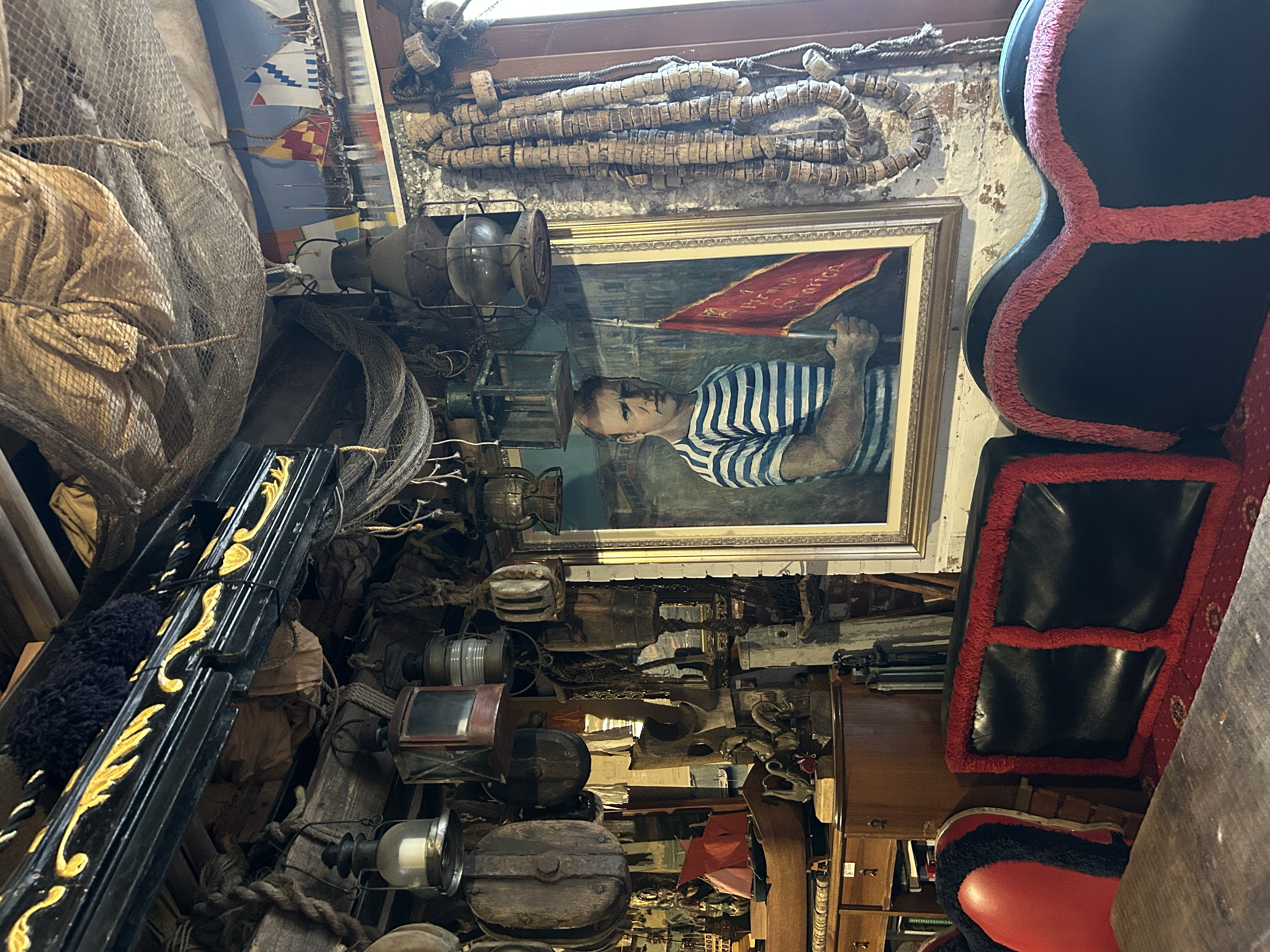
Partway through our afternoon, we pulled up to a squero — a traditional Venetian boatyard — that had been operating for centuries. The word squero comes from the Greek word for carpenter's square, and everything about this place felt rooted in long practice. It was neither a museum nor a tourist attraction, though it welcomed us warmly. It was simply a working yard, doing what it had always done.

Boat hulls in various states of repair leaned against the walls. There were wooden ribs, hand tools, the particular smell of sawdust and lacquer and canal water. There are eight different types of wood traditionally used to build a gondola — each chosen for a specific structural role, from the resilient oak of the hull to the cherry wood used for the ornamental elements. A gondola takes roughly two months to build by hand, costs in the region of forty thousand euros, and requires constant maintenance. The squero crew looked entirely unimpressed by these facts, in the way that people who do extraordinary things every day tend to be.
We stood in the yard surrounded by boat parts and felt very far from the crowds queuing for a ten-minute gondola tour near the Rialto.
Back on the Water
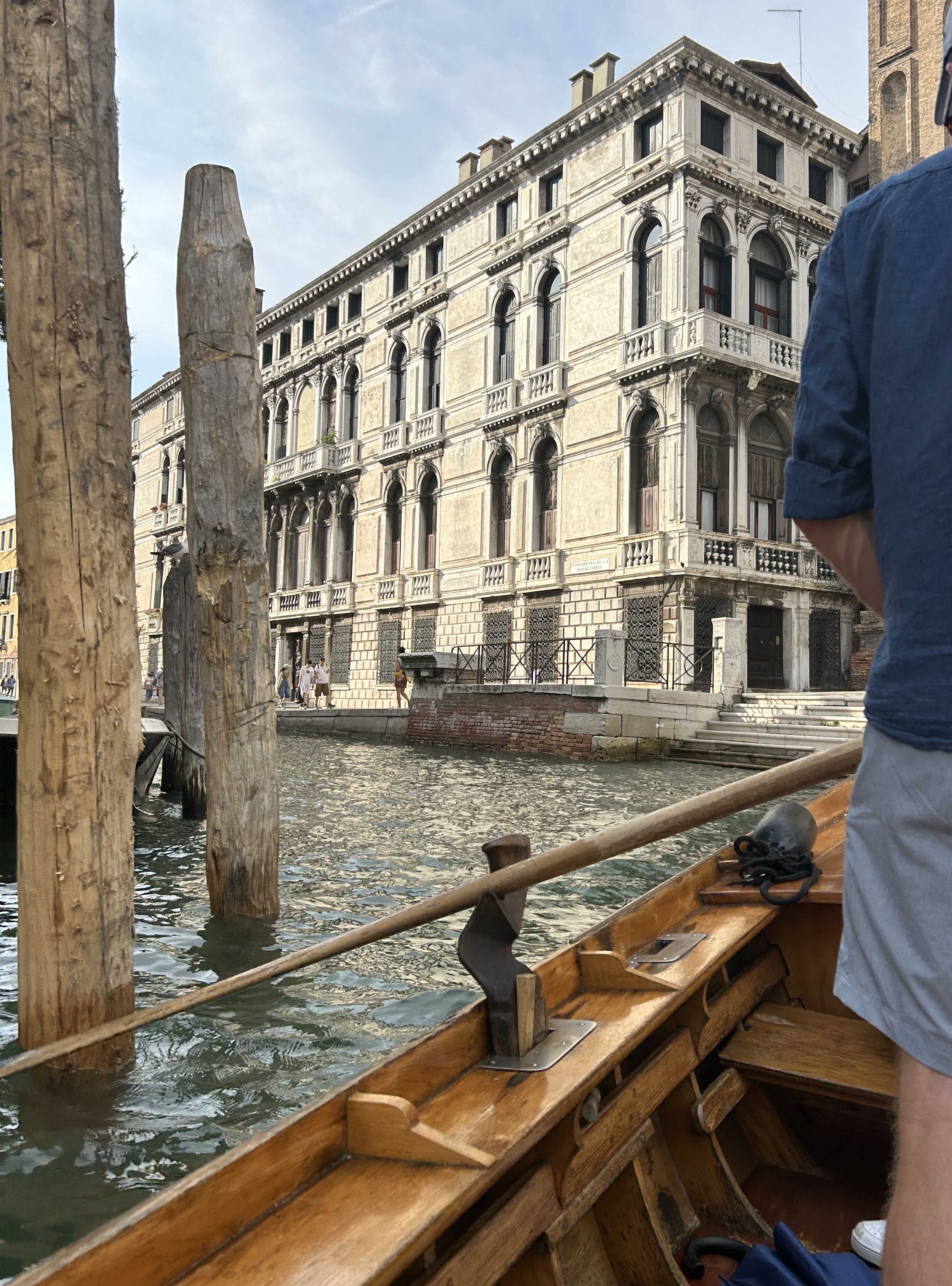
Returning to the batella after the squero visit, the rowing felt different — more considered. Knowing something about how these boats are made, understanding the wood and the intention behind every curve, gave each stroke a slightly different quality. We moved under low stone bridges, the oar angled to clear the arch, and through stretches of narrow canals with moss-covered walls.
The residential Venice around us continued its morning: a woman shaking a rug from a second-floor window, a delivery boat stacked with mineral water cases moving in the opposite direction, an elderly man reading on a bench who looked up, clocked us, and nodded in what felt like approval. Or possibly polite tolerance. Either way, we chose to take it as encouragement.
The Best Possible Ending: Cicchetti and Aperol
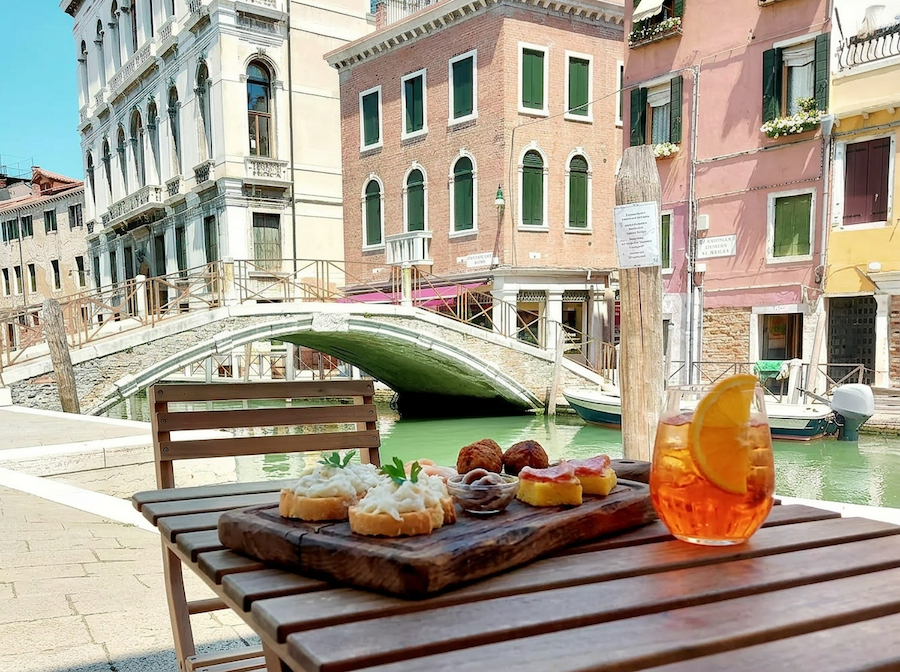
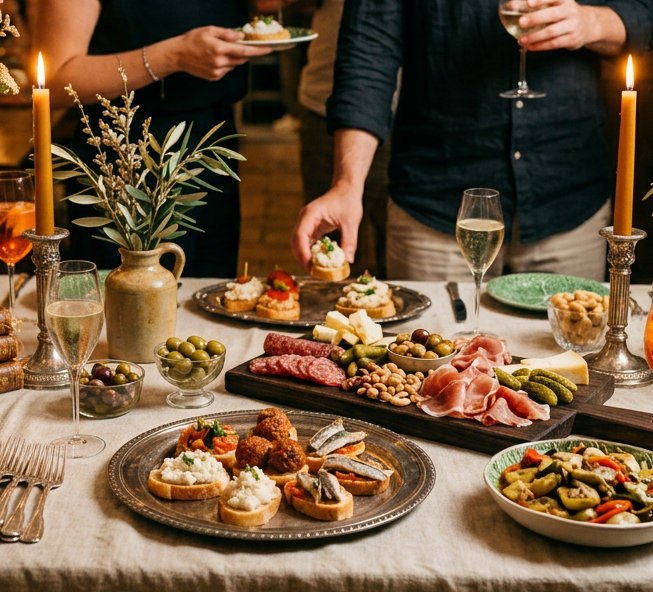
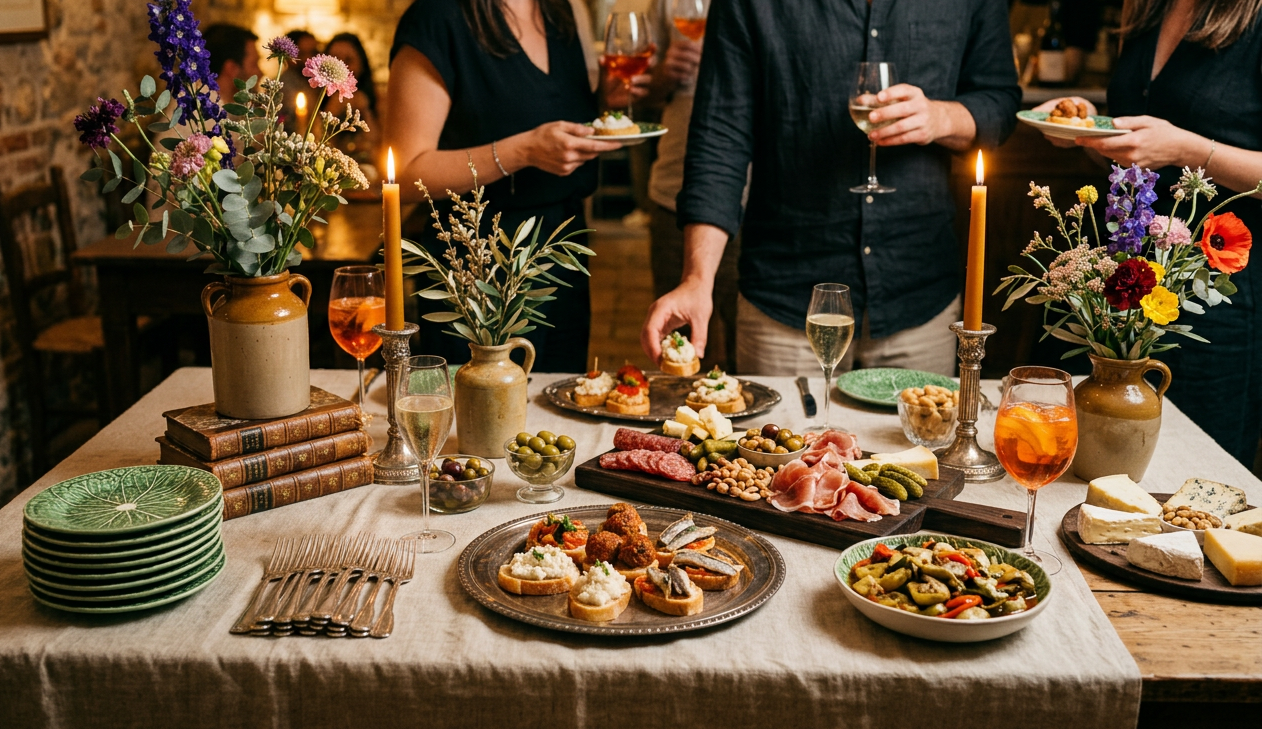
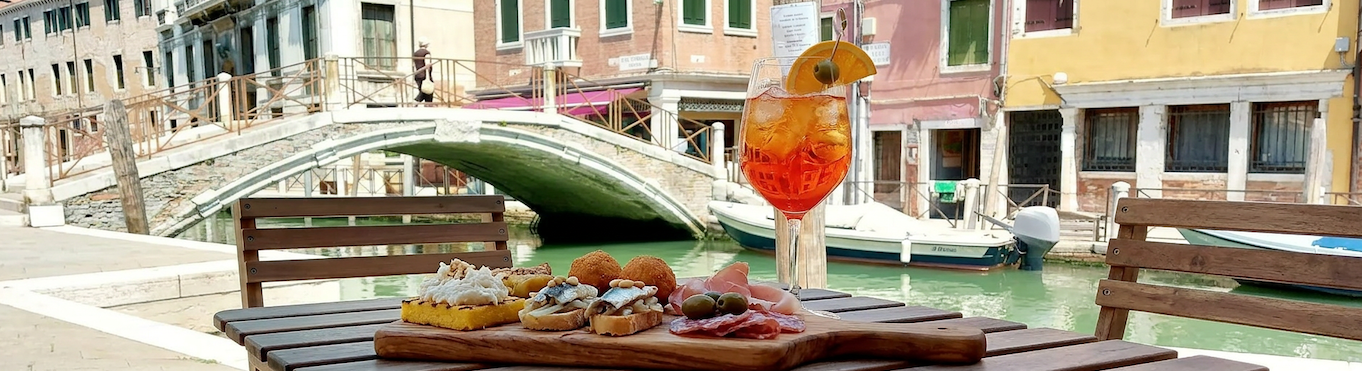
The Squero e Cicchetto package ends exactly the way it should. After mooring the batella, we were led to a spread of cicchetti — the small Venetian bar snacks that are Venice's answer to tapas, and considerably better than that comparison makes them sound. Bacalà mantecato on grilled bread. Nests of proscuitto topped with creamy cheese. Small mouthfuls of things that taste like they've been made by someone who has been making them their whole life, because they have.
Alongside: an Aperol Spritz, that particular shade of burnt orange that looks, in afternoon Venetian light, almost too beautiful to drink. We drank it anyway.
There's a specific kind of tiredness that comes from learning something physical with your whole body — the pleasant ache of muscles that did unfamiliar work, the satisfaction of having actually done a thing rather than watched it done. We sat with that feeling and the cicchetti and the Spritz, and agreed that this was, without much competition, the best afternnoon Venice had given us yet.
If you go, book the Squero e Cicchetto option. Wear flat shoes with grip. Listen carefully to the fórcola instructions. And when you finally find your rhythm on the water, try to stay there as long as you can — because the canals of Venice look very different when you're the one doing the rowing.
What is a batella and how is it different from a gondola?
A batella is one of Venice's oldest traditional rowing boats, distinguished by its symmetrical, double-pointed hull — tapered at both the bow and the stern. A gondola, by contrast, has an asymmetrical hull designed to compensate for the push of a single oar. The batella's pointed rear made it impossible to retrofit with a motor, which is largely why the boat became rare as Venice modernized throughout the twentieth century.
What is the Squero e Cicchetto experience with Row Venice?
The Squero e Cicchetto option combines a hands-on Venetian rowing lesson in a traditional batella with a visit to a historic squero — a working boatyard where gondolas and other traditional vessels are built and repaired. The experience concludes with a tasting of cicchetti (Venetian bar snacks) and an Aperol Spritz. It's one of the more complete ways to understand both the craft and the culture of Venetian watercraft in a single morning.
Is Row Venice really an all-female team?
Yes. Row Venice is staffed by an all-female team of instructors, which is notable given that gondoliering in Venice remains a profession dominated by men — the first officially licensed female gondolier only received her certification in 2010. Row Venice's instructors are highly skilled practitioners of voga alla Veneta, the traditional Venetian standing-row technique.
Do you need any rowing experience to try this?
None at all. Voga alla Veneta — standing and rowing forward-facing — is counterintuitive for anyone used to conventional rowing, so everyone essentially starts from scratch. Row Venice's instructors guide you through the technique from the beginning, and most participants find a workable rhythm within the first twenty to thirty minutes on the water.
Where in Venice does the rowing take place?
The rowing routes typically move through quieter residential canals away from the main tourist corridors, often including the area around the historic Jewish Ghetto — one of the oldest in Europe, established in 1516. These waterways offer a more intimate and authentic experience of the city than the heavily trafficked canals near San Marco or the Rialto.
What is a squero, and can the public visit one?
A squero is a traditional Venetian boatyard where wooden boats — including gondolas — are built, restored, and maintained. They are working yards rather than museums, and most are not open to general visitors. The squero visit included in the Row Venice Squero e Cicchetto experience is a rare opportunity to see the interior of one of these ancient workshops, including the tools, materials, and traditional methods still used today.






.webp)

.webp)
%20(2).webp)
.webp)


.png)